As a general budgeting reference, factory-direct custom stainless steel bottles typically start at around US$2 per unit and can exceed US$8 per unit for more complex OEM projects.
For example, a standard 500ml / 17oz double-wall vacuum-insulated bottle made with a 304 stainless steel inner wall may typically fall in the US$2.50–$4.50 range at commercial production volumes, depending on the lid, finish, packaging, quantity, and Incoterm.
There is no single price for a custom stainless steel water bottle. The final quotation depends on factors such as stainless steel grade, bottle construction, capacity, order volume, lid design, surface finish, logo decoration, packaging, tooling, testing requirements, and shipping terms.
Whether you are sourcing for a brand, wholesale business, retailer, corporate program, or e-commerce store, the lowest unit price is not necessarily the best deal. The more important question is whether every supplier is quoting the same product specification and the same commercial terms.
Quick Answer: Custom Stainless Steel Water Bottle Price Benchmarks
For factory-direct B2B sourcing, the following ranges can be used as initial budgeting references for commercial production:
| Custom Bottle Type | Indicative Factory-Direct Price* | Typical Application |
| Existing product + custom logo | S$2.00–$3.50 / unit | Promotional and corporate programs |
| Existing product + custom color + logo | US$2.50–$4.00 / unit | Branded wholesale products |
| Private label + custom packaging | US$3.00–$5.00 / unit | Retail and e-commerce brands |
| Custom lid / upgraded components | US$3.50–$5.50 / unit | Premium branded products |
| Full OEM + new tooling | US$4.00–$8.00+ / unit | New product development |
These are indicative factory-direct budgeting ranges for commercial B2B production, not fixed quotations. Actual pricing varies according to product specifications, order quantity, customization, tooling, packaging, testing requirements, and Incoterms.
What About Retail Personalized Bottles?
Retail and low-quantity personalized bottles have a very different cost structure.
An individual consumer may pay US$15–$35+ for a personalized bottle, while premium branded products from established drinkware brands can reach US$30–$55+.
These prices should not be compared directly with factory-direct B2B pricing. Retail prices may include individual-order handling, distribution costs, retail margins, marketing expenses, consumer packaging, and fulfillment.
If you are sourcing 500, 1,000, 5,000, or more units for commercial distribution, factory-direct B2B pricing is the more relevant benchmark.
Custom Stainless Steel Water Bottle Cost by Customization Level
The word “custom” can describe very different manufacturing projects. A bottle with your logo is fundamentally different from a completely new OEM design.
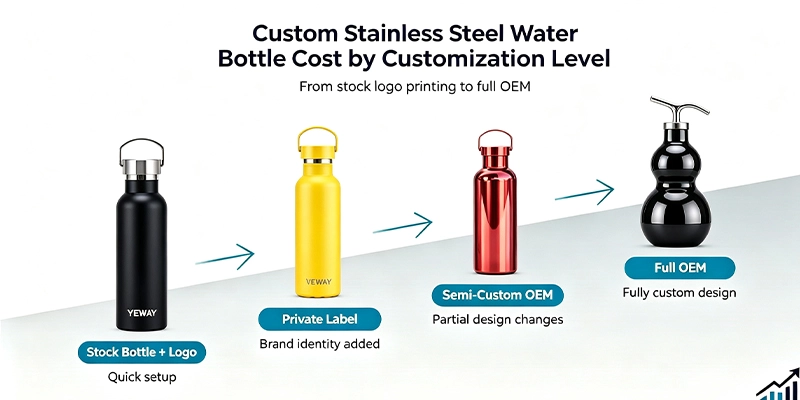
For practical sourcing purposes, custom bottle projects can be grouped into four broad levels:
Stock Bottle + Custom Logo
You select an existing bottle model and add your branding.
Typical customization may include:
- Custom logo
- Standard color
- Basic packaging
- Simple decoration
This is usually the most cost-effective option and works well for corporate programs, promotional campaigns, events, and brands testing a new product.
Private Label Stainless Steel Water Bottle
Private label uses an existing product platform while adding brand-specific elements.
Typical options include:
- Custom brand logo
- Custom color
- Lid selection
- Surface finish
- Branded packaging
- Labels and accessories
Private label is often a practical middle ground between a standard stock product and a more extensively customized OEM project.
Semi-Custom OEM Bottle
For practical sourcing purposes, this category refers to projects that start with an existing product platform but modify selected components or product features.
For example:
- Custom lid
- Custom handle
- Custom surface finish
- Custom accessories
- Brand-specific color
- Custom packaging
This approach can give a brand more product differentiation without requiring every part of the bottle to be developed from scratch.
Full OEM Stainless Steel Water Bottle
For practical sourcing purposes, this refers to projects developed around the buyer’s specifications, which may involve new tooling, proprietary components, or a substantially new product structure.
It may involve:
- Custom bottle shape
- New tooling
- Custom lid design
- New components
- Specialized surface finishing
- Custom packaging
- Product testing
Because development and tooling requirements are greater, these projects generally require a larger development budget, longer lead times, and higher production volumes than simple logo customization.
What Determines the Cost of a Custom Stainless Steel Water Bottle?
A factory quotation is made up of several cost components rather than one single “customization fee.”
A simplified way to view the pricing structure is:
Product Cost = Materials + Manufacturing + Customization + Packaging + Tooling + Testing + Production Volume
The main cost drivers are below.
Stainless Steel Grade
The stainless steel grade affects both material cost and product positioning.
304 Stainless Steel / 18/8
304 stainless steel is widely used for reusable drinkware because it offers a practical balance of durability, corrosion resistance, and cost.
316 / 316L Stainless Steel
316 and 316L contain molybdenum and generally provide higher corrosion resistance than 304. They may be selected for premium products or applications with more demanding material requirements.
Because 316-series stainless steel generally costs more than 304, the choice can affect the final unit price.
Choosing between 304 and 316 depends on your product positioning, performance requirements, and target cost. For a more detailed comparison of the two grades, see our 304 vs. 316 stainless steel sourcing guide for B2B drinkware buyers.
Procurement tip: When comparing supplier quotations, confirm whether the stated stainless steel grade applies to the inner wall, outer wall, or both.
Bottle Capacity and Dimensions
Bottle capacity affects material usage, but it is not the only dimensional factor that determines cost.
Common B2B sizes include:
- 350ml / 12oz
- 500ml / 17oz
- 750ml / 25oz
- 1,000ml / 34oz
The final price can also be affected by:
- Bottle diameter
- Overall height
- Wall thickness
- Bottle shape
- Forming requirements
- Manufacturing yield
A 500ml bottle with a complex shape may therefore cost more than a simpler bottle with a similar capacity.
Single-Wall vs. Double-Wall Vacuum Insulation
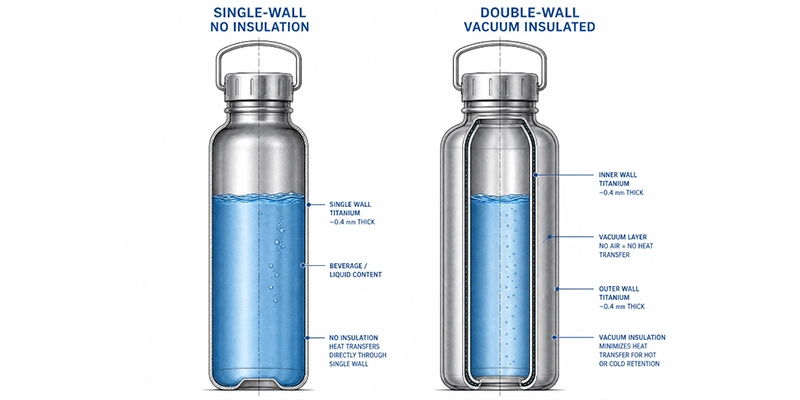
Bottle construction is another major cost driver.
A single-wall stainless steel bottle has a relatively simple construction and generally costs less to manufacture.
A double-wall vacuum-insulated bottle requires additional manufacturing and quality-control processes, including forming and joining the inner and outer walls and creating and verifying the vacuum space.
For brands targeting the performance drinkware market, vacuum insulation can provide greater functional value while increasing manufacturing complexity and cost. For a closer look at how stainless steel water bottles are formed, welded, vacuum-insulated, finished, and tested, see our guide to stainless steel water bottle manufacturing processes.
Lid Design and Drinking Mechanism
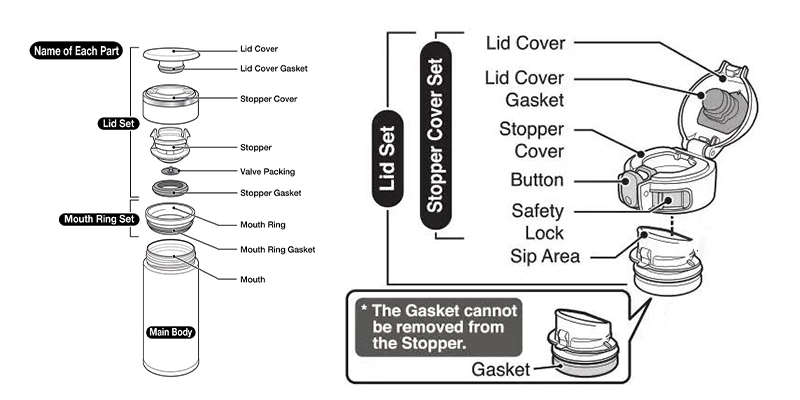
The lid can significantly affect the total product cost.
A basic screw lid is relatively straightforward, while more complex designs may include:
- Straw
- Carry handle
- Flip mechanism
- Push-button opening
- Locking mechanism
- Multiple silicone seals
- Integrated drinking components
Different lid designs can vary significantly in structure, functionality, and component complexity. For a closer look at the available options, see our guide to stainless steel water bottle lid types.
Surface Finish and Color
Surface treatment affects both appearance and production cost.
Common options include:
- Brushed stainless steel
- Polished finish
- Spray coating
- Powder coating
- PVD finishing
- Soft-touch finishes
- Textured matte finishes
- Custom Pantone colors
Standard finishes are generally easier to produce, while special coatings, textures, and custom color matching can add production and setup costs. For a closer look at available custom water bottle surface finishes and decoration options, see our detailed guide.
Logo and Decoration Method
Logo customization can affect the unit cost depending on the decoration method, artwork complexity, coverage area, and production volume.
- Screen Printing:A cost-effective option for simple logos and larger production runs.
- Laser Engraving:A durable option that works particularly well for minimalist or premium branding.
- UV Printing:Suitable for detailed, multi-color graphics and more complex artwork.
- Full-Wrap Printing:Used when a brand needs graphics across a larger portion of the bottle body.
- Embossing and Debossing:Creates a raised or recessed logo directly on the bottle and may require additional tooling.
For buyers searching for engraved stainless steel water bottles or custom metal water bottles with a logo, the decoration method should be specified clearly in the RFQ rather than simply requesting “custom printing.”
Explore our guide to custom water bottle logo printing methods for more details on the available options.
Tooling
Tooling is one of the clearest differences between simple customization and full OEM development.
If you use existing tooling, additional tooling may not be required.
A new OEM product may require tooling for:
- Bottle body
- Lid Handle
- Accessories
- Other custom components
Tooling is normally a one-time development cost, but it can have a significant effect on the economics of smaller production runs.
Instead of comparing tooling costs in isolation, buyers should evaluate:
Total development cost ÷ expected production volume
This gives a more useful picture of the tooling’s effect on unit economics.
Packaging
Packaging should be considered before finalizing the product budget.
Common options include:
- Bulk carton packaging
- Individual polybags
- Standard gift boxes
- Custom printed boxes
- Retail-ready packaging
- Custom inserts
A wholesale buyer supplying corporate events may need simple protective packaging, while an e-commerce or retail brand may require a fully branded retail package.
Testing and Compliance Requirements
Testing requirements depend on the target market, customer specifications, materials, and intended use.
Depending on the project, buyers may request documentation or testing related to:
- Food-contact requirements
- Material safety
- BPA-related requirements for applicable components
- Packaging performance
- Product performance
- Third-party inspection
Do not assume that every certification or test is automatically included in a factory quotation. Confirm the specific requirements for your destination market and product. For a more detailed overview of FDA, LFGB, PFAS, BPA, and other food-contact requirements, see our food-grade drinkware compliance guide.
How Does Order Quantity Affect Custom Water Bottle Cost?
Order quantity is one of the strongest factors affecting factory-direct unit pricing.
Manufacturers incur certain setup and production costs regardless of whether an order contains several hundred or several thousand bottles. These may include:
- Production setup
- Artwork setup
- Color preparation
- Packaging setup
- Quality-control preparation
- Production scheduling
When these costs are spread across a larger production run, the average cost per unit can decrease.
B2B Quantity and Cost Relationship
| Order Quantity | Typical Production Profile |
| 100–500 pcs | Higher unit cost; best suited to selected stock models and simpler customization |
| 500–1,000 pcs | Common starting range for certain custom and private-label projects |
| 1,000–3,000 pcs | Better production economics for many customized projects |
| 3,000–5,000 pcs | More competitive pricing and greater customization flexibility |
| 5,000–10,000 pcs | Suitable for established wholesale and retail programs |
| 10,000+ pcs | Greater opportunity to spread tooling and setup costs across production volume |
These are general production patterns rather than universal MOQ rules. Actual minimums vary by manufacturer, product model, color, customization, and tooling requirements.
Higher volume also does not mean the price will continue falling indefinitely. Once setup costs are spread efficiently, raw materials, production time, components, labor, and logistics become the dominant cost factors.
The right order quantity therefore balances:
Unit Cost + Inventory Risk + Working Capital + Expected Sales
Factory-Direct Price vs. Landed Cost
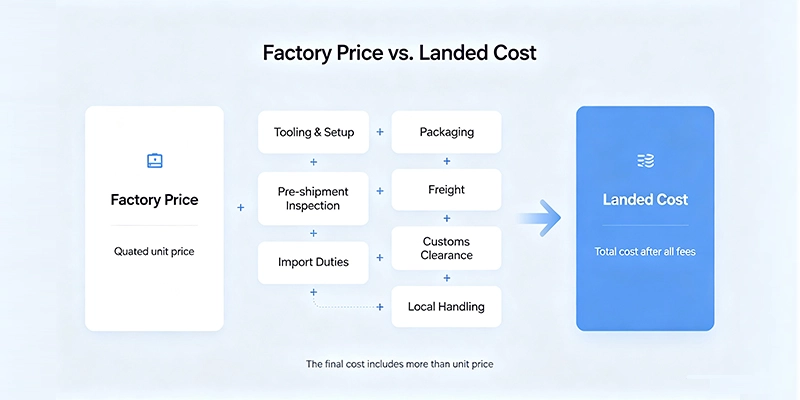
One of the most important distinctions in international sourcing is:
Factory Price ≠ Landed Cost
For example, an EXW or FOB quotation may cover the product and specific stages of the export process, but it does not necessarily represent the cost of getting the goods into your warehouse.
A buyer’s total landed cost may include:
Factory Price + Tooling + Packaging + Inspection + Freight + Duties/Taxes + Customs and Local Handling
This is why a supplier offering a slightly higher factory price can sometimes result in a lower total landed cost if the product specification, packaging efficiency, shipping terms, or quality performance is better.
For margin planning, evaluate the landed cost per unit, not just the number shown on the factory quotation.
What Hidden Costs Should You Check in a Factory Quote?
Before comparing suppliers, confirm whether the following costs are included or quoted separately.
- Tooling and Mold Fees:Does the project require new tooling? If so, is the tooling a one-time charge?
- Samples:Are prototype or pre-production samples included? What about sample shipping?
- Artwork and Setup:Are printing setup, artwork preparation, or other decoration setup costs included?
- Packaging:Does the quoted price include your required retail packaging, or only standard bulk packaging?
- Testing and Inspection:Are required third-party tests or pre-shipment inspections included?
- Freight and Incoterms:Is the quotation based on EXW, FOB, CIF, DDP, or another Incoterm?
These details can make two apparently similar unit prices very different in practice.
How to Compare Custom Stainless Steel Water Bottle Quotes
The best way to compare manufacturers is to send each supplier the same product specification.
Product Specification
Specify:
- Capacity
- Dimensions
- Stainless steel grade
- Inner and outer wall material
- Wall construction
- Vacuum insulation requirement
Lid Specification
Specify:
- Lid type
- Material
- Straw requirement
- Handle
- Silicone components
- Drinking mechanism
Customization
Specify:
- Pantone color
- Surface finish
- Logo position
- Decoration method
- Artwork size
- Coverage area
Packaging
Specify:
- Individual packaging
- Retail box
- Inserts
- Labels
- Barcode requirements
- Master carton requirements
Commercial Terms
Confirm:
- MOQ
- Quantity-based pricing
- Tooling cost
- Sample cost
- Production
- lead time
- Incoterms
- Payment terms
Only after these specifications are aligned can you make a meaningful apples-to-apples supplier comparison.
How to Reduce Custom Stainless Steel Water Bottle Costs
Lowering unit cost does not necessarily mean using cheaper materials.
Instead, look at the major production variables.
Use Existing Tooling
If a suitable existing production platform and tooling can meet your product requirements, you may be able to reduce development costs and shorten the product-development cycle.
Choose the Appropriate Stainless Steel Grade
For many mainstream drinkware applications, 304 stainless steel offers a practical balance between performance and cost. Higher grades should be selected when the application genuinely requires them.
Simplify the Lid
Complex lids can increase component count, assembly time, tooling requirements, and quality-control complexity.
Standardize Components
Using proven lids, seals, handles, and other components can reduce development complexity.
Optimize Packaging
Good packaging protects the product without unnecessarily increasing material usage, package volume, or freight costs.
Scale Production Strategically
Increasing order volume can improve unit economics, but buying more inventory than your sales forecast supports can create additional working-capital and storage costs.
What Should You Ask a Custom Stainless Steel Water Bottle Manufacturer?
Before placing an order, ask:
- What stainless steel grade is used for the inner and outer walls?
- Is the product based on existing tooling or does it require new tooling?
- What is the MOQ per model and color?
- Which logo and decoration methods are available?
- Which lid options are available?
- What packaging is included in the quotation?
- What testing or compliance documentation is available for the product?
- What is the sample lead time?
- What is the mass-production lead time?
- Which Incoterm is the quotation based on?
A reliable manufacturer should be able to explain the quotation rather than simply provide a unit price.
For a broader guide to evaluating factory capabilities, quality control, production capacity, certifications, and supplier reliability, see our guide to choosing a reliable wholesale water bottle manufacturer.
How to Get an Accurate Custom Stainless Steel Water Bottle Quote
The more complete your initial RFQ, the more accurate your quotation is likely to be.
Prepare the following information:
- Bottle capacity
- Bottle shape or reference sample
- Stainless steel grade
- Single-wall or double-wall vacuum construction
- Lid type
- Straw or handle requirements
- Logo artwork
- Surface finish
- Pantone color
- Packaging requirements
- Initial order quantity
- Estimated annual volume
- Target market
- Required compliance documentation
- Target delivery date
You do not need to have every detail finalized before contacting a manufacturer. A capable OEM supplier can help identify which specifications need to be confirmed before final pricing.
If you are planning a larger wholesale purchase, see our guide to how to buy wholesale water bottles for more guidance on product selection, supplier evaluation, ordering, and B2B procurement.
Request a Custom Stainless Steel Water Bottle Quote
Are you sourcing custom stainless steel water bottles for a brand, wholesale business, retail program, or e-commerce product line?
YEWAY is a China-based stainless steel water bottle manufacturer and factory providing OEM, ODM, private label, and wholesale solutions for B2B buyers.
Share your project requirements, including:
- Bottle size and capacity
- Material and construction
- Lid design
- Logo and decoration
- Color and surface finish
- Packaging
- Target order quantity
Our team can review your requirements and provide a factory-direct quotation based on the actual product specification.
Frequently Asked Questions
How much does a custom stainless steel water bottle cost?
Factory-direct custom stainless steel water bottles can cost roughly US$2 to US$8+ per unit, depending on the specification, order volume, customization, tooling, packaging, and other project requirements. For a standard 500ml double-wall vacuum 304 stainless steel bottle, US$2.50–$4.50 per unit can be used as an initial bulk-production budgeting reference.
How much does a 500ml custom stainless steel water bottle cost?
A 500ml / 17oz double-wall vacuum-insulated 304 stainless steel bottle may typically fall within US$2.50–$4.50 per unit at commercial production volumes. The final price depends on the lid, finish, branding, packaging, order quantity, and Incoterm.
How much does it cost to add a logo to a stainless steel water bottle?
The additional cost depends on the decoration method, artwork size, coverage area, and order quantity. Screen printing and laser engraving are commonly used for straightforward branding, while UV printing, full-wrap decoration, and embossing can require additional production or tooling costs.
What is the typical MOQ for custom stainless steel water bottles?
MOQ depends on the bottle model and customization scope. Existing products with simple logo decoration can often support lower MOQs than projects requiring custom colors, packaging, new components, or new tooling. Always confirm the MOQ for the specific model and color you are sourcing.
Is 316 stainless steel more expensive than 304?
Generally, yes. 316 and 316L contain molybdenum and typically cost more than 304 stainless steel. 304 remains a common choice for mainstream stainless steel drinkware because of its balance of performance and cost.
Does a straw lid increase the cost of a custom water bottle?
Usually, yes. A straw lid may require additional components, silicone parts, tooling, and assembly compared with a basic screw lid. The actual difference depends on the specific lid design and production volume.
How much does a custom water bottle mold cost?
Tooling costs vary significantly according to the bottle shape, lid design, number of components, and tooling complexity. Because tooling costs are project-specific, buyers should request a separate tooling quotation rather than relying on a generic industry-wide figure.
What is the difference between Private Label and OEM water bottles?
Private label generally uses an existing product platform with your branding, colors, finishes, and packaging. OEM involves a higher degree of product development and may include custom tooling, components, structures, or proprietary specifications.
Is factory pricing the same as landed cost?
No. Factory pricing such as EXW or FOB does not necessarily include international freight, import duties, customs clearance, local handling, or inland transportation. Landed cost represents the total cost of getting the finished goods to the required destination.
How do I get an accurate price quote for custom bottles?
Provide the manufacturer with the bottle capacity, material, construction, lid, color, decoration method, packaging, target quantity, destination, and any compliance requirements. A complete RFQ allows the manufacturer to quote the actual project rather than a generic bottle.