Choosing the right wholesale tumbler is not simply about finding the lowest unit price.
For retailers, e-commerce brands, coffee businesses, distributors, corporate gift companies, and private label brands, the right tumbler needs to match the target customer, intended use, product positioning, customization requirements, order volume, and budget.
A 40 oz handled tumbler may be a strong choice for a lifestyle brand targeting high-capacity hydration, but it may be unsuitable for a coffee business serving commuters. Likewise, a visually attractive tumbler may not be the right choice for a promotional program if its curved surface limits logo decoration.
Before buying tumblers in bulk, buyers should evaluate more than appearance and price. Tumbler type, capacity, dimensions, lid design, stainless steel construction, insulation, surface finish, customization, MOQ, lead time, packaging, and supplier capability can all affect the commercial success of a product.
This guide provides a practical B2B framework for choosing wholesale tumblers. Rather than simply listing different tumbler styles, it explains how to make the key product and purchasing decisions before requesting a quotation or placing a bulk order.
Quick Answer: How Do You Choose the Right Wholesale Tumbler?
There is no single best wholesale tumbler for every business.
The right tumbler depends on your target customer, sales channel, beverage application, capacity, lid, material, customization level, order volume, and product positioning.
A practical selection process is:
Define your business → Identify your customer → Choose the use case → Select the tumbler type → Choose capacity and dimensions → Select the lid → Evaluate material and insulation → Decide the customization level → Compare MOQ and total cost → Evaluate the supplier → Approve a sample.
| Business Type | What to Prioritize | Tumbler Direction to Consider |
|---|---|---|
| Retail or lifestyle brand | Shelf appeal, versatility, colors, finish | 20–30 oz mainstream tumblers |
| Coffee shop or café | Portability, drinking comfort, compact dimensions | 12–20 oz coffee/travel tumblers |
| E-commerce or Amazon brand | Visual differentiation, features, packaging | Distinctive shapes and functional designs |
| Promotional distributor | Decoration area, logo compatibility, consistency | Decoration-friendly tumblers |
| Outdoor or active brand | Capacity, durability, portability | 30–40 oz+ insulated tumblers |
| New brand testing the market | Lower investment, flexible branding | Existing models with custom logo or private label |
These are starting points rather than universal rules. Your actual choice should be based on the customers and sales channel you are targeting.
1. Start With Your Business and Target Customer
Before choosing a tumbler, define who will buy and use it.
The same stainless steel tumbler can perform very differently depending on the sales channel, customer expectations, and intended application.
A common sourcing mistake is to start with a supplier’s catalog and choose whichever product looks most attractive. A better approach is to start with your market and work backward.
Ask:
- Who is the end customer?
- Where and how will they use the tumbler?
- What beverages will they typically carry?
- What price range fits your market?
- Is the tumbler primarily functional, lifestyle-oriented, or promotional?
- Are you testing a new product or building a long-term product line?
Once these questions are clear, it becomes much easier to narrow down the right tumbler specifications.
Retailers and Lifestyle Brands
Retailers and lifestyle brands usually need tumblers with broad consumer appeal and strong shelf presentation.
Prioritize:
- Versatile sizes
- Attractive colors and finishes
- Comfortable handling
- Easy-to-use lids
- Durable exterior surfaces
- Retail-ready packaging
If you are launching a new collection, avoid assuming that more SKUs automatically mean more sales. A focused selection of well-positioned products can make inventory management and demand testing easier.
Starting direction: Choose a small range of versatile tumbler designs and sizes that match your target customer’s everyday habits.
Coffee Shops and Cafés
Coffee businesses have different priorities.
The tumbler needs to fit naturally into the customer’s coffee routine, particularly if customers are commuters or office workers.
Consider:
- Coffee-friendly capacities
- Compact dimensions
- Comfortable drinking
- Easy lid operation
- Portability
- Insulation performance
A commuter-focused coffee brand may benefit more from a compact travel tumbler than from a large-capacity handled model.
Starting direction: Focus on compact, portable tumblers designed around everyday coffee consumption.
E-Commerce and Amazon Brands
Online brands have less opportunity to demonstrate a product physically, so the product needs to communicate its value quickly through images, video, and product listings.
Prioritize:
- Distinctive product design
- Clear functional benefits
- Strong visual appeal
- Consistent colors and finishes
- E-commerce-friendly packaging
- Features that are easy to demonstrate visually
However, differentiation does not necessarily require a completely new tumbler. An existing factory platform with carefully selected customization can sometimes provide a lower-risk starting point.
Starting direction: Choose a visually distinctive tumbler with one or two clear functional selling points.
Promotional Distributors and Corporate Gift Suppliers
For promotional buyers, the tumbler also needs to function as a reliable branding surface.
Prioritize:
- Decoration area
- Surface geometry
- Logo compatibility
- Consistent coating and color
- Repeatable logo placement
- Packaging options
A simple cylindrical tumbler may therefore be more suitable for a promotional program than a highly sculpted product with limited decoration space.
Starting direction: Choose a decoration-friendly tumbler with a stable, repeatable surface.
Outdoor and Active Lifestyle Brands
Outdoor brands generally need to balance:
- Capacity
- Durability
- Portability
- Insulation
- Secure closure
- Carrying comfort
A large tumbler may create strong perceived value, but buyers should also consider its filled weight, dimensions, and portability.
Starting direction: Choose a durable insulated tumbler whose capacity and dimensions match the actual activities of your target customers.
New Brands Testing the Market
New brands often need to validate demand without committing too much capital to an unproven SKU.
For an initial order, consider:
- Existing factory models
- Limited colors
- Custom logo application
- Standard or lightly customized packaging
- Lower tooling requirements
- A manageable number of SKUs
This allows a brand to test product-market fit before investing in a completely new tumbler structure.
Starting direction: Start with an existing tumbler platform and targeted branding, then move toward deeper customization after demand has been validated.
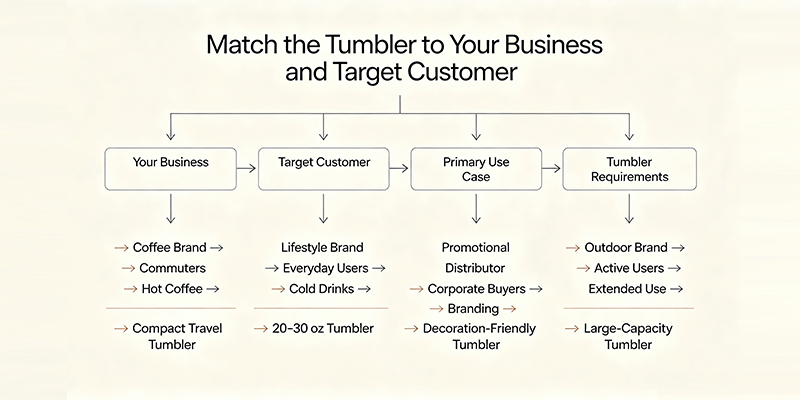
Create a Basic Product Brief Before Contacting Suppliers
Once you understand your business model, create a basic product brief.
For example:
Business: Coffee brand
Target customer: Urban commuters
Primary use: Hot coffee and daily travel
Starting direction: Compact travel tumbler
Key priorities: Portability, drinking comfort, lid usability, insulation
This is much more useful than simply telling a supplier:
“I need a wholesale tumbler.”
A clear product brief gives the supplier enough information to recommend relevant models rather than sending a generic catalog.
The goal at this stage is not to choose the final SKU. It is to define what kind of tumbler your business should be looking for.
2. How to Choose the Right Tumbler Type
Once you understand your customer and use case, choose the tumbler format.
Instead of choosing a tumbler because a particular shape is popular, start with the primary reason your customer will use and buy the product.
Ask:
- What will customers mainly drink?
- Will they carry the tumbler in a car, bag, office, or outdoor environment?
- Do they need direct drinking, a straw, or multiple drinking options?
- Is portability more important than capacity?
- Does the product need strong visual differentiation?
- Will it be an everyday tumbler or a specialized product?
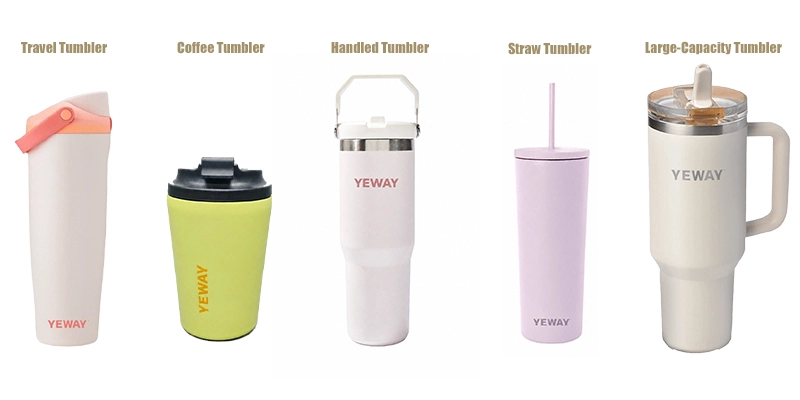
The following formats cover many of the common options used in wholesale tumbler & coffee mug programs, including travel tumblers, coffee tumblers, handled tumblers, straw tumblers, and large-capacity designs.
Travel Tumblers
Choose a travel tumbler when portability and everyday commuting are major priorities.
Consider:
- Compact dimensions
- Secure lids
- Comfortable handling
- Cup-holder compatibility
- Easy drinking
- Practical capacity
Best fit: Coffee businesses, commuters, office-focused retailers, and everyday lifestyle brands.
Coffee Tumblers
Choose a coffee tumbler when hot coffee or tea is the primary application.
Pay attention to:
- Drinking opening
- Lid usability
- Comfortable grip
- Heat protection
- Compact dimensions
- Portability
Best fit: Coffee shops, cafés, coffee brands, office users, and commuter-focused products.
Handled Tumblers
Choose a handled tumbler when carrying comfort and larger capacity are important selling points.
However, the handle also affects:
- Packaging dimensions
- Storage
- Shipping volume
- Cup-holder compatibility
- Weight
- Ergonomics
Evaluate the handle together with the filled weight rather than treating it as purely decorative.
Best fit: Lifestyle brands, high-capacity drinkware programs, and markets where large tumblers are popular.
Straw Tumblers
Choose a straw tumbler when frequent sipping and cold beverages are central to the product’s use case.
Evaluate:
- Straw connection
- Lid sealing
- Drinking angle
- Cleaning access
- Replacement components
- Spill resistance
A straw system adds convenience but also introduces additional components that need to work reliably together.
Best fit: Lifestyle brands, fitness-oriented products, cold-beverage applications, and large-capacity tumblers.
Slim Tumblers
Choose a slim tumbler when portability and limited storage space are more important than maximum capacity.
Check the actual:
- Body diameter
- Base diameter
- Height
- Capacity
- Weight
Do not rely solely on the word “slim” in a product description.
Best fit: Urban commuters, office users, travel products, and compact drinkware programs.
Large-Capacity Tumblers
Choose a large-capacity tumbler when high beverage volume is a major part of the product’s value proposition.
Before selecting a 30 oz, 40 oz, or larger tumbler, consider:
- Filled weight
- Overall height
- Base diameter
- Handle ergonomics
- Cup-holder compatibility
- Packaging dimensions
- Shipping efficiency
- Cleaning
A larger tumbler is not automatically a better product. The physical dimensions need to make sense for the target customer.
Best fit: Lifestyle brands, outdoor products, and high-capacity hydration programs.
Multi-Function Tumblers
Choose a multi-function tumbler when product differentiation and flexible drinking options are important.
For example, a 3-in-1 coffee tumbler can combine:
- Direct drinking
- Slide-lid drinking
- Straw drinking
This allows one tumbler to support several drinking preferences and beverage scenarios.
For a brand, this can create a stronger product proposition than a standard single-function tumbler.
However, additional functions also increase:
- Component count
- Product complexity
- Tooling requirements
- Assembly requirements
- Quality-control requirements
- Potential failure points
Multi-function products should therefore be selected because the additional functions solve real customer needs—not simply because the product has more features.
Best fit: Differentiated lifestyle brands, innovative coffee brands, and retailers looking for a stronger product proposition.
Which Tumbler Type Should You Start With?
| Primary Customer Need | Tumbler Type to Consider |
|---|---|
| Daily commuting | Travel tumbler |
| Coffee and tea | Coffee tumbler |
| Easy carrying with larger capacity | Handled tumbler |
| Frequent cold-drink sipping | Straw tumbler |
| Compact portability | Slim tumbler |
| Maximum beverage capacity | Large-capacity tumbler |
| Product differentiation | Multi-function tumbler |
These categories can overlap. A single product can be both a handled tumbler and a straw tumbler.
The important point is to identify the primary reason customers will buy the product and select the format around that reason.
3. How to Choose the Right Tumbler Size and Dimensions
After choosing the general tumbler type, the next step is to determine the right capacity and physical dimensions.
Capacity should not be selected independently from the product’s intended use.
A 16 oz tumbler and a 40 oz handled tumbler may both be technically excellent products, but they serve very different customer needs.
Match Capacity to the Beverage and Use Case
As a general starting point:
| Application | Capacity Direction to Consider |
|---|---|
| Espresso or smaller coffee servings | 8–12 oz |
| Coffee and commuter use | 12–20 oz |
| Everyday lifestyle use | 20–30 oz |
| Larger hydration needs | 30–40 oz+ |
These are starting ranges rather than universal standards.
The right capacity depends on your market, beverage application, customer behavior, and product positioning.
Check Height and Diameter
Capacity alone does not tell you whether a tumbler will work for your customers.
Also request:
- Overall height
- Maximum body diameter
- Base diameter
- Empty weight
- Handle dimensions
- Lid height
For example, a tumbler may have a suitable capacity but be too tall for a typical vehicle cup holder.
Consider Cup-Holder Compatibility
For travel and commuter products, cup-holder compatibility can be a critical specification.
Do not simply ask whether a supplier’s tumbler is “cup-holder friendly.”
Ask for the actual base diameter and compare it with the intended cup-holder dimensions.
Consider Filled Weight
Large-capacity tumblers can become surprisingly heavy when filled.
This matters for:
- One-handed carrying
- Handle comfort
- Daily commuting
- Older users
- Outdoor use
- E-commerce positioning
A high-capacity tumbler should therefore be evaluated based on both its empty and filled weight.
Consider Packaging and Shipping Dimensions
Larger tumblers can also increase:
- Carton volume
- Storage requirements
- Shipping cost
- Retail shelf space
For B2B buyers, the physical size of the finished product can affect the economics of the entire supply chain.
The right capacity is not simply the largest capacity you can sell. It is the capacity that creates value for your customer without creating unnecessary usability or logistics problems.
4. How to Choose the Right Tumbler Lid
The lid directly affects how the tumbler is used.
A tumbler with excellent insulation and attractive finishing can still perform poorly if the lid is difficult to drink from, difficult to clean, or unsuitable for the customer’s daily routine.
Choose the lid based on:
- Drinking method
- Beverage type
- Portability
- Cleaning
- Spill resistance
- Product positioning
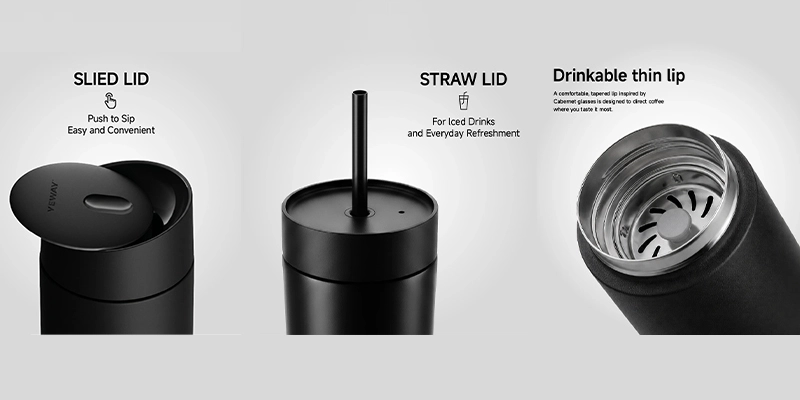
Slide Lids
Choose a slide lid when simple, convenient drinking is the priority.
They can work particularly well for coffee and travel tumblers.
Evaluate:
- Opening size
- Sliding mechanism
- Seal design
- Cleaning
- Drinking comfort
Best fit: Coffee shops, cafés, commuters, and everyday travel tumblers.
Flip Lids
Choose a flip lid when one-handed operation and controlled closure are important.
Check:
- Hinge durability
- Closure mechanism
- Seal performance
- Ease of opening
- Cleaning access
Best fit: Commuters, active users, and travel products.
Straw Lids
Choose a straw lid when frequent sipping and cold beverages are central to the product.
Check:
- Straw diameter
- Connection
- Seal
- Drinking angle
- Splash resistance
- Cleaning
- Replacement components
Best fit: Large-capacity tumblers, lifestyle brands, fitness-oriented products, and cold beverages.
Multi-Function Lids
Choose a multi-function lid when your product needs to support different drinking preferences.
A 3-in-1 coffee tumbler, for example, may allow customers to drink directly, use a slide-lid opening, or switch to a straw lid.
This can make one SKU suitable for several use cases.
However, more functions also mean more components and more potential quality-control points.
Check:
- How each drinking mode works
- Component interchangeability
- Seal performance
- Cleaning
- Replacement parts
- Assembly consistency
Evaluate the Lid and Body as One System
Before approving a tumbler, verify:
- Lid-to-body fit
- Seal performance
- Overall product height
- Drinking opening position
- Handle clearance
- Straw clearance
- Cleaning accessibility
- Replacement-part compatibility
For custom projects, changing the lid can affect dimensions, tooling, packaging, and production.
For a deeper technical comparison, see our Tumbler Lid Types & Selection Guide.
5. How to Choose the Right Stainless Steel, Inner Surface, and Insulation
Once the tumbler type, size, and lid are defined, evaluate the internal construction.
For wholesale buyers, this decision should go beyond asking whether a product uses 304 or 316 stainless steel.
The construction should match the:
Beverage → Customer expectations → Product positioning → Durability requirements → Thermal performance
304 vs. 316 Stainless Steel
For most everyday tumblers, 304 food-grade stainless steel provides a practical balance of corrosion resistance, durability, and cost.
316 stainless steel offers higher corrosion resistance and may be appropriate for more demanding applications where that additional resistance provides meaningful value.
However, a higher material grade is not automatically a better commercial choice.
The correct question is:
Does the additional material specification solve a real requirement for this product?
For a detailed comparison, see our guide to 304 vs. 316 stainless steel for drinkware.
Consider the Inner Surface and Beverage Type
Most everyday stainless steel tumblers are suitable for common beverages such as water, coffee, and tea.
However, some buyers place greater emphasis on flavor neutrality and reducing taste or odor retention, particularly for specialty coffee or tea.
In these situations, a ceramic-lined or ceramic-coated interior may be worth considering.
| Drinking Application | Inner Construction to Consider |
|---|---|
| Water and everyday beverages | Food-grade stainless steel |
| General coffee and tea | 304 stainless steel |
| Specialty coffee or tea | Stainless steel or ceramic-lined interior |
| Premium beverage products | Evaluate inner surface as part of product positioning |
Ceramic-lined tumblers should also be evaluated for:
- Coating durability
- Adhesion
- Impact resistance
- Cleaning requirements
- Thermal performance
- Production consistency
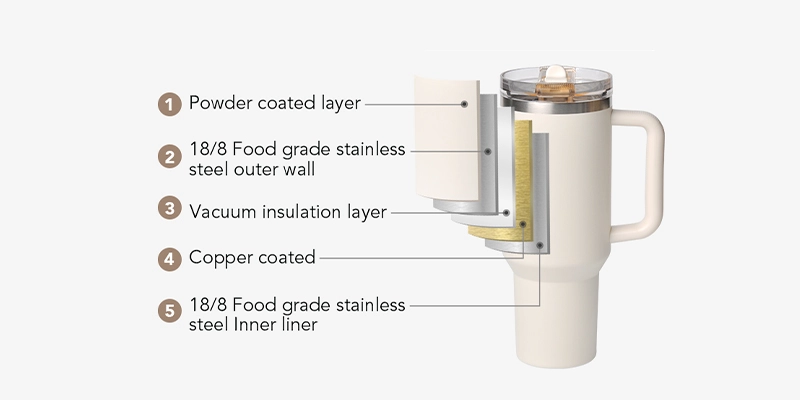
Look for Double-Wall Vacuum Insulation
Most high-performance insulated tumblers use double-wall construction with a vacuum layer between the walls.
When evaluating a wholesale tumbler, ask about:
- Inner and outer wall construction
- Vacuum insulation process
- Testing method
- Hot and cold retention
- Production consistency
- Quality-control procedures
Do not evaluate insulation only from marketing claims.
Consider the Complete Insulation System
Some vacuum-insulated tumblers use a copper layer to reduce radiant heat transfer.
The important question is not simply whether copper is present.
It is whether the complete insulation construction delivers the required thermal performance consistently.
Ask the supplier how the insulation is constructed and tested.
Match Construction to Product Positioning
Everyday retail tumbler:
304 stainless steel with reliable vacuum insulation may provide a practical balance of cost and performance.
Coffee or tea-focused tumbler:
A standard stainless steel interior may be suitable, while a ceramic-lined option may be worth considering when flavor experience is an important selling point.
Premium lifestyle tumbler:
Higher-end finishing, refined inner construction, and stronger insulation performance may support premium positioning.
Outdoor or sports tumbler:
Enhanced corrosion resistance may be worth considering when the application genuinely requires it.
Verify Food-Contact and Compliance Requirements
Depending on the destination market, verify:
- Stainless steel material specifications
- Food-contact safety
- Plastic component requirements
- Silicone seal requirements
- Inner coating or ceramic lining requirements
- Applicable testing reports
- Market-specific compliance requirements
Make sure the documentation applies to the exact tumbler model and configuration you are ordering.
Define Thermal Performance Before Ordering
Claims such as “24-hour cold” are only meaningful when the testing conditions are clear.
Ask about:
- Starting temperature
- Ambient temperature
- Test duration
- Measurement location
- Test method
- Acceptance criteria
For B2B purchasing, a defined performance requirement is more useful than a generic marketing claim.
For a detailed explanation of how to evaluate tumbler insulation performance, see our Tumbler Insulation Quality guide.
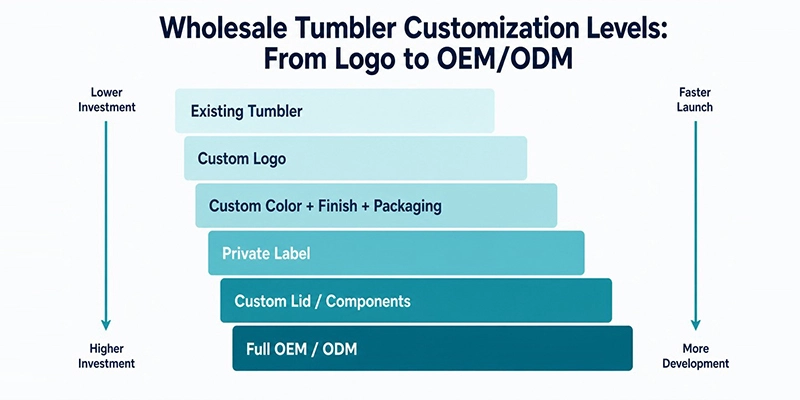
6. Decide How Much Customization You Actually Need
Not every wholesale buyer needs a completely new tumbler.
In many cases, an existing factory model with the right branding can be faster, less expensive, and lower risk.
There are three common approaches:
- Existing tumbler + custom logo
- Private label tumbler
- Full OEM/ODM development
Existing Tumbler + Custom Logo
Choose an existing tumbler with custom branding if you want to launch quickly or test market demand.
Common options include:
- Laser engraving
- Screen printing
- UV printing
- Custom colors
- Selected surface finishes
Best for: New brands, promotional orders, corporate gifts, and market testing.
If you already have a tumbler model in mind and mainly need your brand logo applied, see our custom water bottle logo service to explore available branding options.
Private Label Tumblers
Choose private label when you want stronger brand ownership without developing a completely new structure.
Depending on the project, customization can include:
- Brand colors
- Logo
- Packaging
- Labels
- Lid configuration
- Surface finish
Best for: Growing and established brands.
If you want to build a branded tumbler line using an existing product platform, see our private label water bottle service for more information about branding and product customization options.
Full OEM/ODM Tumbler Development
Choose OEM/ODM when existing products cannot deliver the differentiation or functionality you need.
This may involve:
- Custom body dimensions
- New tooling
- Proprietary shapes
- Custom lids
- Custom components
- Unique finishes
- Custom packaging
- Prototype development
OEM/ODM provides more control but also increases development complexity, tooling investment, and lead time.
Best for: Established brands, proprietary product concepts, and long-term differentiated product lines.
If your project requires a custom tumbler structure, lid, dimensions, or other product-specific development, see our OEM/ODM drinkware manufacturing service to learn more about the development process and available capabilities.
How Much Customization Do You Need?
| Business Situation | Starting Point |
|---|---|
| Testing a new market | Existing model + logo |
| Promotional order | Existing model + logo |
| New branded collection | Private label |
| Growing brand | Private label + selected customization |
| Unique product concept | OEM/ODM |
| Proprietary shape or lid | OEM/ODM |
| Long-term flagship product | OEM/ODM |
More customization does not automatically mean a better business decision.
If an existing product already solves the customer’s problem, new tooling may add cost without creating enough additional commercial value.
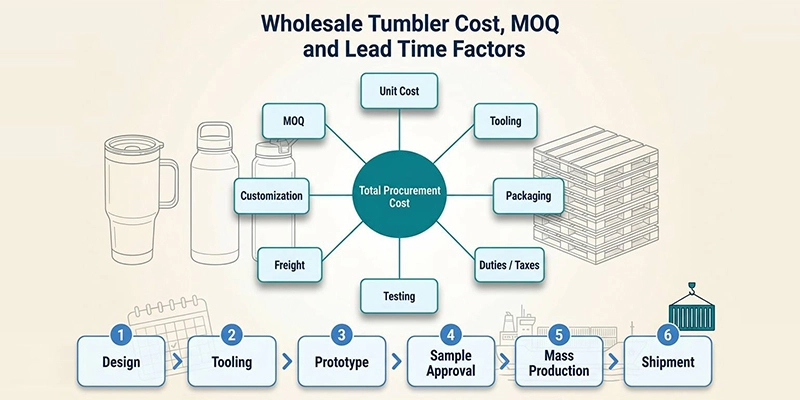
7. Compare MOQ, Cost, and Lead Time Before Ordering
Once the product specification is defined, determine whether the project makes commercial sense.
The lowest unit price is rarely the only factor that matters.
You should also consider:
MOQ + customization + tooling + packaging + shipping + inventory risk + lead time
Understand What the MOQ Actually Applies To
A supplier’s MOQ may apply to:
- Total order quantity
- Color
- Size
- Lid
- Customized component
- Packaging
Instead of asking only:
“What is your MOQ?”
Ask:
“What is the MOQ for this exact tumbler configuration?”
Compare Total Procurement Cost
A useful framework is:
Product cost + customization + tooling + packaging + shipping = estimated landed cost
A tumbler with a slightly higher unit price may be more economical if it has better carton utilization or a lower MOQ.
Consider Tooling Costs
For custom products, clarify:
- Tooling cost
- Whether tooling is included
- Whether it is one-time
- Who owns the tooling
- Whether tooling can be reused
- Whether costs can be credited against future orders
Match MOQ to Expected Sales
A lower unit price does not necessarily justify a larger order.
Consider:
Expected monthly sales × desired inventory coverage = practical initial quantity
For a new product, demand validation may be more important than maximizing the first-order price break.
Understand the Full Lead Time
A custom tumbler project may involve:
Design → Tooling → Prototype → Sample Approval → Mass Production → Packaging → Shipment
Ask which stages are included in the supplier’s quoted lead time.
Ask About Reorder Lead Time
If the product succeeds, the reorder process becomes critical.
Ask:
- Standard reorder lead time
- Repeat-order MOQ
- Color consistency
- Finish consistency
- Tooling retention
- Replacement component availability
A supplier capable of predictable reorders may be more valuable than the supplier with the lowest initial quotation.
8. How to Evaluate a Wholesale Tumbler Supplier
Choosing the right tumbler is only half of the sourcing decision.
The supplier determines whether the product can actually be produced consistently at the required quality, quantity, cost, and timeline.
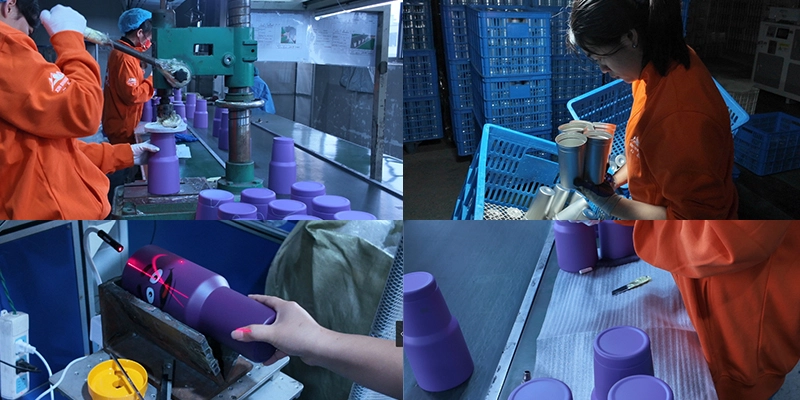
Verify Manufacturing Capability
Determine who controls:
- Product development
- Tooling
- Production
- Quality control
- Surface finishing
- Lid assembly
- Packaging
- Final inspection
For OEM/ODM projects, direct access to the manufacturing team can simplify development and problem solving.
Check Experience With Your Product Type
Ask whether the supplier regularly manufactures:
- Vacuum-insulated tumblers
- Travel tumblers
- Coffee tumblers
- Large-capacity handled tumblers
- Multi-function lids
- Ceramic-lined tumblers
- Custom tumbler bodies
- Private label drinkware
Relevant experience matters because different products require different tooling, sealing, finishing, and assembly processes.
Evaluate Customization Capability
Separate basic from advanced customization.
Basic:
- Logo
- Color
- Finish
- Packaging
Advanced:
- Custom body
- Custom lid
- New tooling
- Special components
- Proprietary structure
Ask:
“Which parts of the tumbler can you actually develop or customize?”
Review Quality Control
Ask how the supplier controls:
- Material
- Vacuum performance
- Lid sealing
- Component assembly
- Surface finish
- Logo placement
- Color consistency
- Packaging
- Final inspection
Verify Testing and Compliance
Ask for relevant documentation covering:
- Stainless steel
- Plastic components
- Silicone seals
- Inner coatings
- Food-contact safety
- Applicable market requirements
Verify that the documents apply to the exact model being purchased.
Evaluate Communication
Before placing a large order, see whether the supplier can clearly answer questions about:
- Specifications
- MOQ
- Pricing
- Tooling
- Samples
- Production schedule
- Packaging
- Testing
- Shipping
For custom projects, written confirmation of key specifications is especially important.
Test the Supplier With Samples
Evaluate both the product and the supplier.
Check:
- Dimensions
- Material
- Lid fit
- Sealing
- Drinking experience
- Surface finish
- Color
- Logo quality
- Packaging
Also observe how the supplier handles revisions.
Evaluate Long-Term Supply Capability
Ask:
- Can the same specifications be reproduced?
- Can order volume increase?
- Are replacement components available?
- Can colors and finishes remain consistent?
- Can the supplier support future product development?
The best supplier is not necessarily the one with the longest capability list.
It is the supplier that can consistently produce the tumbler you selected at the required quality, quantity, cost, and timeline.
For a deeper supplier-selection framework, see How to Choose a Reliable Stainless Steel Tumbler Manufacturer.
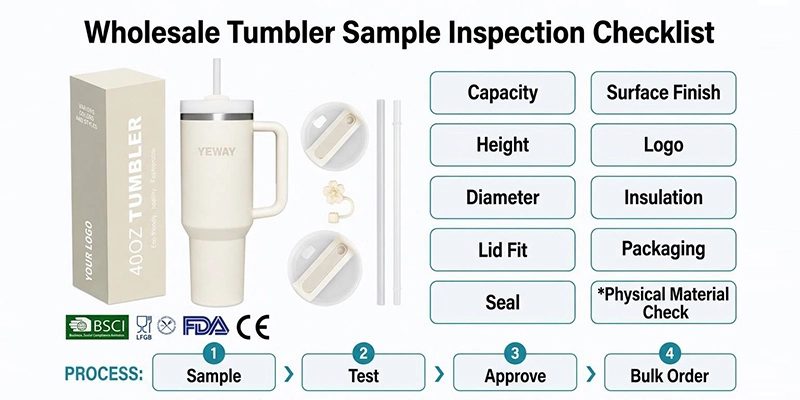
9. Request Samples and Validate the Tumbler Before Bulk Ordering
Do not move directly from quotation to mass production.
A sample allows you to verify whether the product actually meets your requirements.
Start With a Written Specification
Include:
- Capacity
- Dimensions
- Stainless steel grade
- Inner surface
- Insulation
- Lid
- Handle
- Finish
- Color
- Logo
- Packaging
- Performance requirements
- Compliance requirements
Check the Physical Product
Measure:
- Capacity
- Height
- Body diameter
- Base diameter
- Weight
- Lid dimensions
Compare the measurements with the approved specification.
Test the Lid in Real Use
Check:
- Drinking comfort
- Opening and closing
- Seal performance
- Splash resistance
- Straw operation
- Handle clearance
- Disassembly
- Cleaning
Test With the Intended Beverage
Test the tumbler with the beverages your customers will actually use.
Pay attention to:
- Taste
- Odor
- Residue
- Cleaning
- Inner-surface condition
- Lid performance
For ceramic-lined products, inspect the coating carefully for visible defects or damage.
Verify Thermal Performance
Establish:
- Starting temperature
- Ambient temperature
- Test duration
- Measurement method
- Acceptance criteria
Use the same conditions when comparing suppliers.
Inspect Surface Finish and Branding
Check:
- Color
- Surface texture
- Coating consistency
- Logo position
- Logo size
- Logo sharpness
- Edge quality
- Visible defects
Evaluate Packaging
Check whether:
- The tumbler is protected
- Accessories are secured
- Retail packaging fits correctly
- Branding is accurate
- Packaging survives normal handling
- Carton dimensions are practical
Approve a Pre-Production Sample for Complex Projects
For OEM/ODM projects, request a pre-production sample when tooling, colors, components, or other major specifications have changed.
The final approved sample should represent the configuration that will enter mass production.
The purpose of sampling is not simply to decide whether you like the tumbler. It is to verify that the product can meet your commercial requirements before you commit to bulk inventory.
If you want to evaluate a tumbler before committing to a bulk order, you can request tumbler samples from the supplier.
10. Common Wholesale Tumbler Buying Mistakes
Choosing Based Only on Price
The lowest unit price does not necessarily mean the lowest overall procurement cost.
Consider shipping, quality, customization, MOQ, and expected returns.
Choosing a Trending Size Without Checking Your Market
A popular tumbler size in one market may not fit another.
Base the decision on customer behavior rather than trends alone.
Adding Too Many Features
More features can mean:
- Higher cost
- More components
- More assembly
- More potential failure points
Add features only when they provide meaningful customer value.
Ordering Too Many SKUs Too Early
Too many sizes, colors, lids, and finishes can create unnecessary inventory complexity.
Start with a focused product range when testing a market.
Skipping Samples
A supplier’s specification sheet and product photos cannot replace physical validation.
Relying on Marketing Claims
Terms such as “premium,” “leakproof,” or “24-hour cold” should be supported by specifications, testing, or samples where appropriate.
Ignoring Reorder Capability
If a product succeeds, you need the supplier to reproduce the same specifications, colors, finishes, and quality.
A good wholesale tumbler is not only one that works for the first shipment. It is one that can support your business as demand grows.
11. Wholesale Tumbler Buying Checklist
Before placing a bulk tumbler order, confirm the following.
Product Selection
- Target customer defined
- Intended use identified
- Tumbler type selected
- Capacity confirmed
- Height and diameter checked
- Cup-holder requirements checked where relevant
Lid and Usability
- Lid matches customer drinking habits
- Drinking method is appropriate
- Sealing tested
- Cleaning evaluated
- Replacement components confirmed
Material and Construction
- Stainless steel grade specified
- 304 vs. 316 decision justified
- Inner surface selected
- Ceramic lining considered where relevant
- Vacuum construction confirmed
- Thermal requirements defined
Customization
- Custom body required or not
- Logo method selected
- Custom color required or not
- Packaging requirements defined
- Private label requirements defined
- Tooling requirements confirmed
Purchasing
- MOQ confirmed
- MOQ per color/SKU confirmed
- Unit price confirmed
- Price breaks confirmed
- Tooling cost confirmed
- Packaging cost confirmed
- Production lead time confirmed
- Reorder lead time confirmed
- Carton dimensions confirmed
Supplier Verification
- Manufacturing capability verified
- Relevant tumbler experience confirmed
- OEM/ODM capability confirmed if needed
- Quality-control process reviewed
- Compliance documentation reviewed
- Communication evaluated
- Repeat-order capability confirmed
Sample Approval
- Physical sample received
- Dimensions checked
- Lid tested
- Beverage tested
- Insulation tested
- Surface finish checked
- Logo checked
- Packaging checked
- Final specification documented
If you cannot confidently answer these questions, the product is probably not ready for a large bulk order.
12. Frequently Asked Questions About Wholesale Tumblers
What should I consider when choosing wholesale tumblers?
Start with your target customer and intended use. Then evaluate tumbler type, capacity, dimensions, lid design, material, inner surface, insulation, customization, MOQ, cost, and supplier capability.
What is the best tumbler size for wholesale?
There is no universal best size.
12–20 oz tumblers can work well for coffee and commuter applications, while 20–30 oz models are common for everyday use. Larger 30–40 oz+ tumblers may be suitable for high-capacity hydration markets.
The right size depends on your customers and sales channel.
Is 304 or 316 stainless steel better for tumblers?
Both can be suitable.
304 provides a practical balance of durability, corrosion resistance, and cost for many everyday applications. 316 offers higher corrosion resistance and may be appropriate when the application justifies it.
Should I choose a ceramic-lined tumbler?
A ceramic-lined interior may be worth considering when flavor neutrality is particularly important, such as for some coffee- or tea-focused products.
Evaluate coating durability, adhesion, impact resistance, cleaning, and production consistency before choosing it.
Which tumbler lid should I choose?
Choose the lid according to the customer’s actual drinking and carrying habits.
Slide lids can suit coffee and commuting, flip lids can provide controlled closure, straw lids can work well for cold beverages, and multi-function lids can support multiple drinking methods.
Should I choose an existing tumbler or develop a custom OEM tumbler?
Existing models are generally simpler for market testing and faster launches.
Private label provides more differentiation, while OEM/ODM makes more sense when you need a unique structure, proprietary lid, or specialized product.
What MOQ should I expect for wholesale tumblers?
MOQ depends on the product and customization level.
Always confirm whether MOQ applies to the total order, color, SKU, lid, packaging, or customized component.
How do I know if a tumbler supplier is reliable?
Evaluate manufacturing capability, product experience, customization, quality control, testing documentation, communication, samples, lead times, and repeat-order capability.
Should I order samples before a bulk tumbler order?
Yes.
Samples allow you to verify dimensions, materials, lid performance, insulation, finish, branding, packaging, and usability before committing to bulk inventory.
13. Choose the Right Wholesale Tumbler for Your Business
Choosing a wholesale tumbler is not simply a matter of finding a popular shape or the lowest factory price.
The right product needs to fit your:
Target customer → Beverage application → Capacity → Lid → Material → Insulation → Customization → MOQ → Budget → Sales velocity
A practical sourcing process is:
Define your market → Choose the tumbler type → Select capacity and dimensions → Choose the lid → Evaluate material and insulation → Decide the customization level → Compare MOQ and total cost → Evaluate suppliers → Approve samples → Place the bulk order
This approach helps you avoid committing to inventory before the most important product and purchasing decisions have been validated.
If you are sourcing tumblers for a retail collection, coffee brand, promotional program, corporate gifting business, or private label product line, start by defining the specifications that matter most to your customers.
Need Help Choosing a Wholesale Tumbler?
If you already know your target market but are unsure which tumbler configuration is the best fit, YEWAY can help you evaluate suitable tumbler options based on your application, capacity, lid requirements, customization level, and expected order volume.