In the premium drinkware industry, the transition from standard stainless steel to SUS 316L is more than just a material upgrade—it is a commitment to engineering excellence. For B2B brand owners targeting the high-end outdoor, medical-grade, or professional coffee markets, understanding the “L” factor is critical to ensuring long-term product durability and brand reputation.
This guide moves beyond basic comparisons to analyze the metallurgical advantages of Low-Carbon 316L and why it is the secret to eliminating common manufacturing defects like weld-zone corrosion.
The Science of the “L”: Preventing Intergranular Corrosion
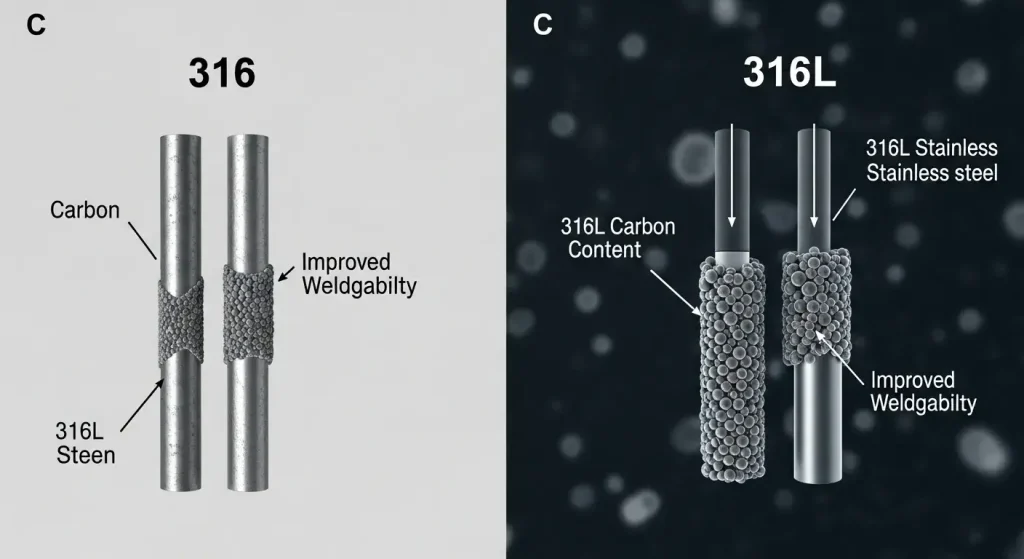
The “L” in 316L stands for Extra-Low Carbon (less than 0.03%). While a 0.05% difference in carbon might seem negligible, it drastically changes the steel’s behavior during high-temperature manufacturing.
The Challenge: Sensitization
During the laser welding of vacuum-insulated flasks, temperatures reach a range (450°C to 850°C) where standard steel undergoes Sensitization. In this state, carbon atoms react with chromium to form chromium carbides at the grain boundaries.
- The Result: The area around the weld (the Heat Affected Zone) becomes depleted of chromium, making the most vulnerable part of your bottle prone to rusting—a fatal flaw for premium brands.
- The 316L Solution: Because 316L has a carbon content below the critical threshold, it prevents carbide precipitation. This ensures that the weld seams remain as chemically stable and corrosion-resistant as the base material.
Technical Specifications: The PREN Advantage
For procurement managers, the quality of a bottle should be measured by its PREN (Pitting Resistance Equivalent Number). The inclusion of Molybdenum (2.0% – 3.0%) in 316L significantly elevates this value.
PREN = Cr + 3.3 \times Mo + 16 \times N
- Standard SUS 304: Offers a PREN of approximately 18—ideal for daily water hydration.
- SUS 316L: Boasts a PREN of 24 to 26. This makes it the “Marine Grade” champion, capable of resisting the corrosive “pitting” caused by chlorides in coffee, sports drinks, or coastal environments.
Manufacturing Excellence: 316L and Electropolishing
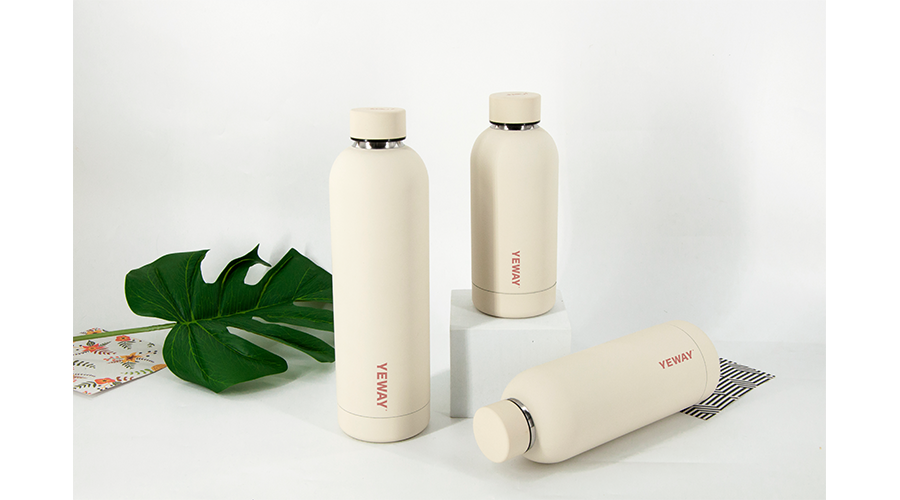
At YEWAY, we utilize 316L not just for its chemistry, but for its compatibility with advanced finishing processes:
- Superior Weld-Zone Integrity: Our precision laser welding on 316L creates a seamless bond that maintains vacuum integrity for years, preventing the “rust ring” often found in lower-grade alternatives.
- Electropolished Purity (EP): 316L responds exceptionally well to Electropolishing. Unlike mechanical polishing, EP creates a microscopic mirror-finish that eliminates odor retention and makes the interior “easy-rinse”—a massive selling point for premium coffee and protein shaker brands.
Strategic Sourcing: Is 316L Worth the Premium?
For most mass-market projects, SUS 304 (18/8) remains the most cost-effective compliant solution. However, you should specify SUS 316L if:
- Market Positioning: Your brand is marketed as “Professional-Grade” or “Life-Long Quality.”
- Specialized Use: The product is designed for high-acidity beverages (cold brew coffee, kombucha) or extreme outdoor/marine use.
- Risk Mitigation: You want to minimize after-sales claims related to weld-line rusting or metallic aftertaste.
Quality Assurance at YEWAY
We eliminate the risk of “material fraud” through a multi-stage verification process:
- Carbon Analysis: We verify that every batch of 316L is strictly below the 0.03% carbon ceiling.
- Spectrometer Testing: Real-time analysis of Nickel and Molybdenum levels.
- Salt Spray Validation: Accelerating corrosion tests to ensure our 316L products exceed international durability standards.
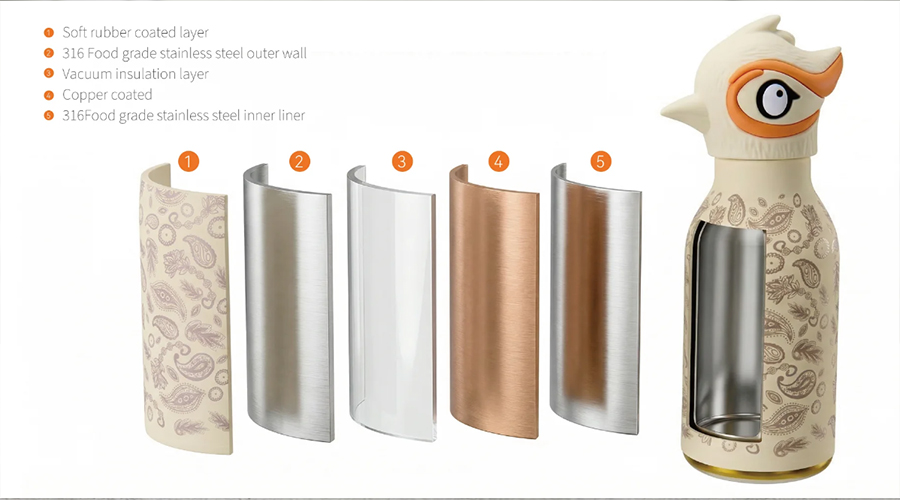
Built for Safety: The multi-layered structure of YEWAY’s 316L kids insulated bottle.
B2B Internal Linking & Technical Resources
Fundamental Knowledge: If you are new to material sourcing, we recommend starting with our [Ultimate 304 vs. 316 Sourcing Guide] to understand the baseline differences in cost and global usage.
Safety Focus: For projects involving school-aged users, specialized safety protocols are required. See our [Kids’ Water Bottle Safety & Compliance Guide] for industry-specific insights.
FAQ for Sourcing Managers
Q: Can I use 316L for the inner liner and 304 for the outer shell?
A: Yes. This is a common cost-optimization strategy. The 316L inner liner provides the chemical protection where it matters most, while the 304 outer shell maintains structural strength at a lower cost.
Q: Does 316L support custom finishes like PVD or Powder Coating?
A: Absolutely. 316L is an excellent substrate for high-end PVD (Physical Vapor Deposition) plating, giving your bottles a luxury metallic look with unmatched durability.
👉[Request a Technical Consultation and 316L Sample Kit from YEWAY]