In the global drinkware manufacturing sector, a common misconception among new B2B importers is that a “kids’ bottle” is simply a smaller version of an adult flask. From an engineering and regulatory standpoint, this couldn’t be further from the truth. While adult drinkware focuses on thermal efficiency and lifestyle aesthetics, children’s products are governed by a complex web of international safety laws and physiological requirements.
As a professional Kids Water Bottle Manufacturer, YEWAY understands that for our partners in North America and Europe, the difference between these two categories is the difference between a high-margin success and a catastrophic product recall. This guide provides a 1,200-word deep dive into the technical, chemical, and ergonomic disparities between kids’ and adult stainless steel bottles.
The Regulatory Divide: CPSIA vs. Standard FDA Compliance
For any B2B buyer, the most significant difference lies in the legal framework. Adult bottles must be food-safe, but kids’ bottles must be “hazard-proof.”
- CPSIA (Consumer Product Safety Improvement Act): In the United States, any product intended for children under 12 is subject to the CPSIA. This involves rigorous third-party testing for lead content in every component—not just the steel, but also the powder coating, the silicone gaskets, and the plastic lids. Adult bottles rarely undergo this level of forensic laboratory scrutiny.
- Phthalate Restrictions: While many adult plastics are BPA-free, children’s products must also be free of specific phthalates (plasticizers) that are often found in cheaper PVC or low-grade silicone. At YEWAY, our Wholesale Kids Water Bottle production utilizes medical-grade, platinum-cured silicone to ensure 100% compliance with these invisible but vital standards.
Metallurgical Selection: Why 316 Steel is the New Standard for Kids
While 18/8 (Grade 304) stainless steel is excellent for adults who primarily drink water or coffee, children’s usage patterns demand a more resilient alloy.
- Resistance to Acidic Corrosion: Children frequently consume fruit juices, milk, and electrolyte drinks. These liquids can be highly acidic. Over time, acidity can cause “pitting corrosion” in standard 304 steel.
- The 316 Advantage: By upgrading the inner liner to 316 Stainless Steel, we introduce Molybdenum into the alloy. This provides superior resistance to chloride and acid-induced leaching. For a premium brand, offering a 316-liner bottle for kids is a powerful “Trust Signal” that justifies a higher retail price point.
Ergonomics: Engineering for “Small-Hand” Dexterity
An adult’s hand can easily exert 30-50 kg of grip strength; a five-year-old may only exert 5-8 kg. This massive difference dictates every dimension of the bottle.
- Diameter and Leverage: Most adult bottles have a diameter of 70mm to 90mm. For a child, the “Golden Zone” for a secure grip is 62mm to 66mm. Anything larger increases the drop rate, leading to potential injury or product damage.
- Friction Management: Adults often prefer “sleek” or “smooth” finishes. For kids, we implement High-Tactile Powder Coating and 5D Relief Textures. These aren’t just decorative; they provide much-needed friction for small, often damp hands in a school or playground setting.
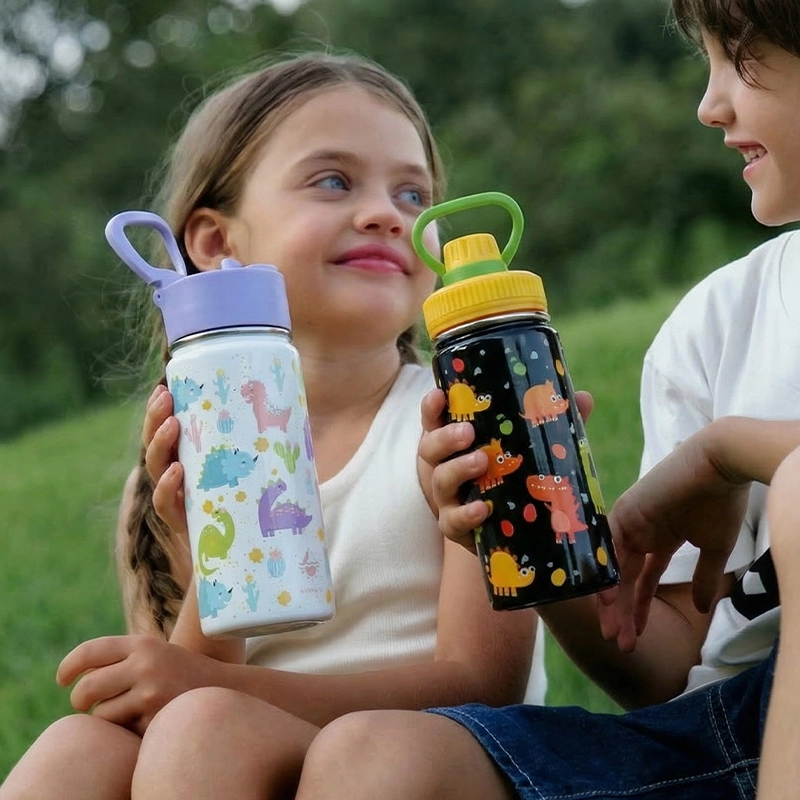
Yeway children’s water bottles are suitable for small hands to hold.
Lid Engineering: Preventing Choking and Scalding Hazards
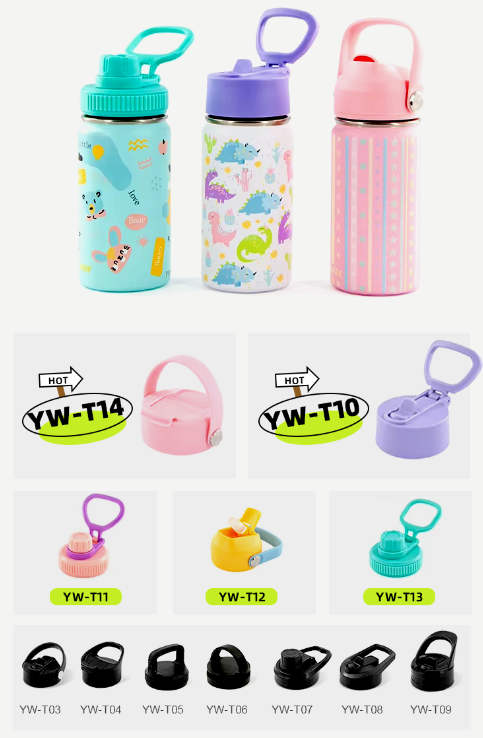
leak-proof lightweight and fun designs for kids Stainless Steel Water Bottle
The lid is where most safety failures occur in the kids’ hydration category.
- Small Parts & Tension Testing: Every component of a kids’ lid—from the straw tip to the vent valve—must pass a “Pull Test” (usually 15 lbs of force). If a part breaks off, it becomes a Choking Hazard, a leading cause of toy and bottle recalls.
- Vented Flow Control: Adult “chug” lids allow for massive water flow. For children, we engineer Air-Vented Straw Systems. This balances the internal pressure, allowing the child to drink without a “vacuum effect” that could lead to choking or gagging.
- One-Click Lock 2.0: Our kids’ lids feature a dual-lock system. It requires enough coordination to prevent accidental opening in a backpack, but is ergonomic enough for a 4-year-old to operate independently.
Manufacturing Specification Comparison Matrix
| Technical Metric | Adult Insulated Flasks | YEWAY Kids’ Professional Series |
| Primary Material | 304 Stainless Steel | 316 or Certified 304 (CPSIA) |
| Coating Type | Standard Paint / Matte | High-Grip Powder / 5D Texture |
| Impact Testing | 1.0m Drop Test | 1.5m Repeated Drop Test |
| Lid Compliance | FDA Food Grade | CPSIA / LFGB / REACH compliant |
| Sealing Tech | Standard Silicone Ring | Over-molded Anti-Microbial Silicone |
Thermal Performance: Safety vs. Retention
Adults prioritize “24 hours hot.” For children, safety outweighs extreme heat retention.
- Scalding Prevention: In the B2B world, we advise against marketing “12 hours hot” for kids’ bottles. Instead, we focus on “24 Hours Cold.” Engineering a bottle that keeps milk cold all day in a warm backpack is a much more valuable (and safer) selling point for parents than a bottle that might scald a child’s mouth.
Strategic Sourcing: Why Your Factory Choice Matters
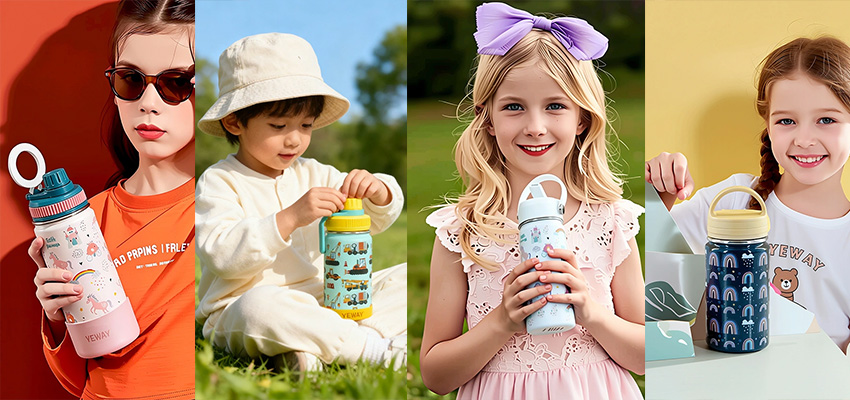
If you are an importer looking to build a brand, you cannot use a generic “Water Bottle Factory.” You need a Custom Kids Water Bottle Manufacturer who understands the liability landscape.
- Batch Traceability: We provide spectrograph reports for every batch of steel used. This is your insurance policy. If a regulatory body ever questions your product, you have the data to prove the material purity.
- Tooling Precision: Kids’ bottles require tighter tolerances in the threads and seals to ensure they remain leak-proof even after being thrown around a classroom or playground.
FAQ: Critical Questions for B2B Sourcing Managers
Q: Is the 316 upgrade worth the cost for the kids’ market?
A: Absolutely. From a marketing perspective, “Medical-Grade Stainless Steel” is one of the highest-converting keywords for premium baby and kids’ brands in 2026.
Q: How do we handle “Back-to-School” volume surges?
A: Strategic partners should lock in production by Q1 for an August launch. As a high-volume factory, we prioritize early-season orders to ensure delivery before the peak retail window.
Q: Are your coatings lead-free?
A: Every powder coating we use is certified lead-free (<90ppm) per CPSIA standards. We provide third-party lab reports (SGS/TUV) for every color in your collection.
Final Verdict: The Professional Edge
Success in the children’s market is built on a foundation of trust. By acknowledging the technical and regulatory differences between adult and kids’ bottles, you position your brand as a premium, safety-conscious leader.
At YEWAY, we specialize in bridge-engineering: we bridge the gap between “Cute Designs” and “Hard-Core Safety Standards.” Connect with our engineering team today to request a compliance-ready prototype for your next project.