
If you’re sourcing stainless steel bottles for the US or EU, you’re not just buying a product. You’re buying a promise that the container won’t poison your customer—or get your shipment stuck in customs.I’ve seen containers sit at Long Beach port for weeks because the lab report came back showing lead in the paint. I’ve seen European buyers reject entire batches because the silicone gasket smelled like rubber. That’s not a quality issue—it’s a survival issue for your brand.
Here’s what actually matters when you’re looking for a China water bottle factory and need a partner who understands global food safety standards—not just as a checkbox, but as a core competency.
The Compliance Trap: What Actually Gets Shipments Held
Before we dive into standards, let’s talk about what customs labs actually test for. Because the gap between “this passes our internal check” and “this passes US Customs” is where most brands lose money.
| Risk Area | What Gets Tested | Why Shipments Fail |
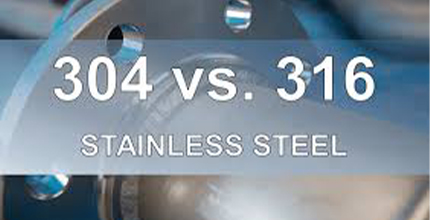
| Metal Composition | 304 vs 316L stainless steel grade verification | Supplier claimed 316L but delivered lower-grade 304 |
| Coatings & Paint | Lead, cadmium, heavy metal migration | Cheap powder coating contains trace lead (Prop 65 violation) |
| Plastic Components | BPA, phthalates, plasticizers | Lids or straws made with recycled or low-grade resin |
| Silicone Seals | Volatile organic compounds, odor migration | Gasket absorbs factory fumes, fails LFGB sensory test |
| Assembly | Overall migration into food simulants | Multiple compliant parts assembled = non-compliant total |
This is why YEWAY doesn’t just test finished products. We test every component, every batch of raw material, and every color run before production starts.
FDA vs. LFGB: Don’t Let the Alphabet Soup Confuse You
- FDA is the ticket to entry for the US market. It’s baseline safety. If your bottle doesn’t pass FDA heavy metal migration tests, don’t even bother booking the container.
- LFGB (the German standard) is what European retailers actually respect. It’s FDA, but with an attitude problem.
Why? Because LFGB includes something called sensory testing. They literally smell your product. They taste the water after it’s been sitting in the bottle. If that silicone gasket picks up a weird flavor from the factory floor? Fail. If the powder coating has even a hint of solvent? Fail.
Most Asian factories can pass FDA. The ones that pass LFGB consistently? Those are the ones who control their raw materials from day one.
| What’s Tested | FDA (US) | LFGB (EU) |
| Heavy metals (lead, cadmium) | Yes | Yes |
| Chemical migration | Yes | Yes, plus additional “migration into food simulants” |
| Sensory (smell/taste) | No | Mandatory |
| Phthalates in plastics | Limited scope | Comprehensive ban |
| Why it matters | You can sell | You can sell without returns |
And if you’re shipping to Europe, don’t forget REACH compliant drinkware requirements. REACH is the EU’s broader chemical regulation framework. LFGB covers food contact; REACH covers everything else in the manufacturing process. YEWAY builds to both.
California Prop 65: The Trap Most Factories Don’t See Coming
If you’re shipping to California, FDA doesn’t protect you. Prop 65 is a separate beast.
Here’s how factories get burned: The stainless steel body tests fine. But the powder coating—the color layer—contains trace lead. Not enough to kill anyone, but enough to trigger California’s warning label requirement.
Once that label goes on your bottle, good luck selling it at premium retail.
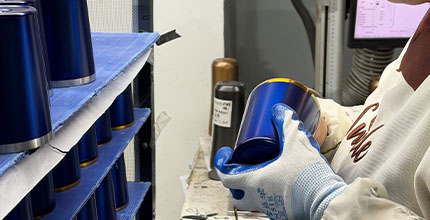
We don’t play that game. YEWAY uses 100% lead-free powder coating. Every color run gets tested. Not because we have to, but because we’ve seen too many brands get blindsided by cheap paint.
If your supplier can’t show you a Prop 65 compliance report for their coatings, walk away.
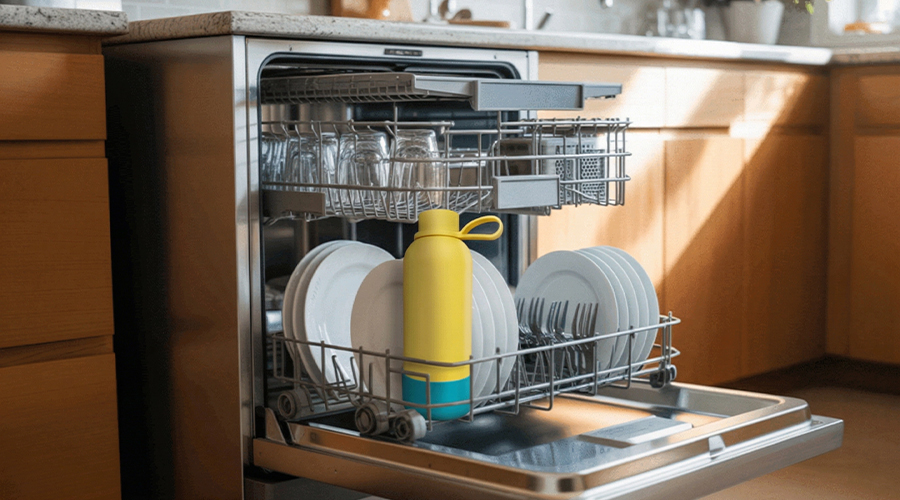
And here’s something most buyers don’t ask about: dishwasher durability.
Our lead-free powder coating isn’t just compliant on day one. It’s engineered for high-temperature durability, ensuring no chemical migration even after 50+ dishwasher cycles. That matters because compliance isn’t static—if the coating breaks down in a commercial dishwasher, you’ve got a problem six months after sale.
The Parts You Can’t See (That Will Get You in Trouble)
Smart buyers check the steel. Rookie buyers forget the rest.
A bottle is an assembly. The steel body might be surgical grade 316L food grade stainless steel. But the silicone gasket inside the lid? The Tritan straw? The PP plastic threads?
Those are the failure points.
- BPA is the obvious one. But there are a dozen other plasticizers—phthalates, bisphenols, flame retardants—that EU regulations are watching.
- Silicone needs to be high-density and non-porous. If it’s cheap, it absorbs odors. And LFGB will catch that smell test every time.
YEWAY specs every component. We don’t buy generic seals off a catalog. We formulate our silicone to be tasteless, odorless, and compliant with both FDA and LFGB migration limits. Your wholesale stainless steel bottles are only as clean as their weakest part.
Traceability: Because “Trust Me” Doesn’t Clear Customs
Here’s a question for your current supplier: If a problem shows up in six months, can you tell me exactly which batch it came from?
Most can’t.
At YEWAY, every production run is logged. We can trace a specific bottle back to the steel coil it was stamped from, the shift that assembled it, and the lab report that cleared it.
This isn’t just paperwork. It’s insurance. When a big box retailer asks for proof that your factory is clean, you hand them a file, not a promise.
We work with SGS and Intertek because third-party eyes keep us honest. If you’re sourcing FDA approved flasks or looking for a certified OEM/ODM drinkware partner, you need a factory that treats testing as routine, not an exception.
Beyond Compliance: Why Buyers Are Asking About Sustainability in 2026
Here’s what’s changed in the last 18 months.
Major retailers aren’t just asking “Is this compliant?” They’re asking “How do you make this, and can you prove it’s clean?”
Sustainable supply chain verification is becoming a purchasing condition for Fortune 500 brands. They want to know:
- Where does your stainless steel come from?
- Is your supply chain transparent?
- Do you monitor working conditions?
- Can you document your environmental impact?
Ethical manufacturing isn’t a marketing angle—it’s a risk management tool for your buyers. When a brand’s reputation is on the line, they need to know their bulk drinkware manufacturing partner operates with integrity at every level.
YEWAY maintains full documentation on material sourcing, factory conditions, and environmental compliance. We don’t hide behind “it’s complicated.” We lay it out.
Compliance isn’t a marketing badge. It’s a cost of doing business with serious partners.
If you’re tired of guessing whether your factory is cutting corners on materials, or if you’re launching a new line and need to know it won’t get hung up at port—
Talk to us.
We’ll show you the test reports before we show you the price list. That’s how you build a brand that lasts.
Frequently Asked Questions
Does FDA approval cover the silicone gaskets in water bottles?
Yes and no. FDA sets limits for food contact materials, but many factories test only the bottle body. At YEWAY, we test every component separately—including gaskets, seals, and lids—because assembly-level compliance requires part-level control.
What is the penalty for Prop 65 non-compliance in California?
Penalties can reach $2,500 per violation per day. For a batch of 10,000 bottles, that’s potentially catastrophic. More importantly, the brand damage from a Prop 65 lawsuit is often worse than the fine.
Is 304 stainless steel always food-grade compliant?
No. “304 stainless” is a grade of steel, but compliance depends on the specific alloy composition and manufacturing process. Low-quality 304 can contain impurities that migrate into beverages. That’s why YEWAY uses verified 316L food grade stainless steel for critical components—it offers better corrosion resistance and higher purity.
What’s the difference between LFGB and REACH?
LFGB specifically regulates materials that contact food. REACH covers all chemicals used in manufacturing—including processing aids, lubricants, and packaging materials. For full EU compliance, you need both.
LFGB specifically regulates materials that contact food. REACH covers all chemicals used in manufacturing—including processing aids, lubricants, and packaging materials. For full EU compliance, you need both.
Looking for the full technical specs? [Contact our team] to request test reports or discuss your next project.
Leave a Reply