S’well is known for its sleek design, premium finishes, and strong insulation performance. It is particularly appealing to urban commuters, corporate gifting programs, and lifestyle retailers. Its slim silhouette and distinctive finishes help it stand out from other insulated water bottles.
Hydro Flask, on the other hand, appeals to users who value durability, versatility, and outdoor functionality. It offers practical drinking options, multiple lid styles, and a product range suited to outdoor activities and everyday hydration.
S’well vs. Hydro Flask: Which stainless steel water bottle is better? As a professional stainless steel water bottle manufacturer, we’ll compare these two brands from several angles, including manufacturing, design philosophy, target audience, market positioning, cost-effectiveness, everyday usability, and durability.
1. Insulation Performance
Insulation is one of the main reasons consumers choose stainless steel water bottles. Two key factors affect thermal performance: the bottle opening and the integrity of the vacuum-insulated structure.
Both S’well and Hydro Flask use vacuum insulation and follow their respective manufacturing standards, but their insulation technologies and product designs are different.
1.1 Narrow Mouth vs. Wide Mouth
In fact, the basic principle behind heat loss in insulated water bottles is quite simple: heat mainly escapes through the bottle opening. The wider the opening, the greater the surface area available for heat transfer through radiation and convection.
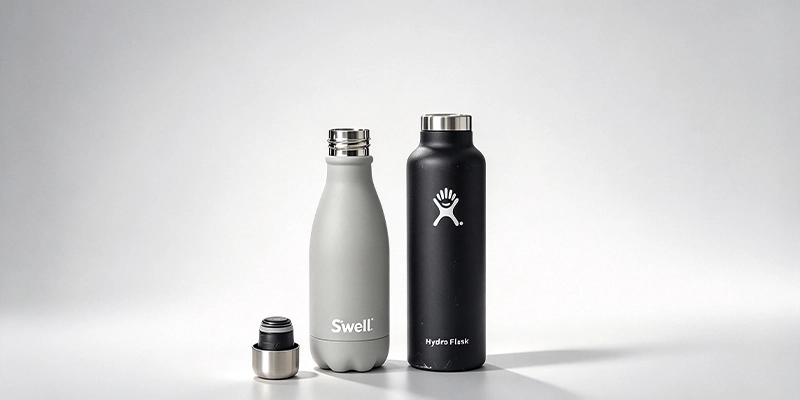
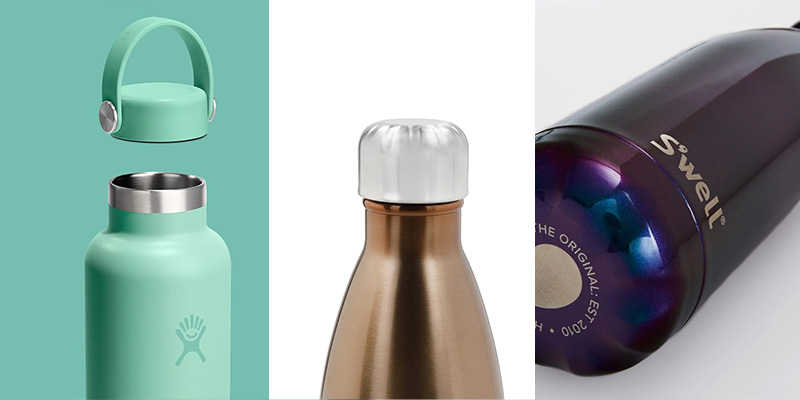
The traditional S’well Original Bottle has a relatively narrow opening, measuring around 34–44 mm in diameter. A smaller opening helps reduce heat loss, giving S’well a natural advantage in heat retention.
Hydro Flask, on the other hand, uses a wide-mouth design, with an opening diameter of 54 mm or more. The wider opening makes the bottle easier to clean and fill with ice, offering a more satisfying drinking experience when enjoying cold drinks. However, a wider opening also allows heat to escape more quickly.
| Design Feature | S’well (Narrow Mouth) | Hydro Flask (Wide Mouth) |
|---|---|---|
| Opening diameter | 34–44 mm | 54 mm and above |
| Insulation | Narrow opening can help reduce heat exchange when open | Wide opening offers greater access but exposes more liquid when open |
| Ice compatibility | Larger ice cubes may be difficult to add | Easy to add ice cubes |
| Cleaning | A small bottle brush may be needed | Easier access with a sponge or bottle brush |
| Drinking experience | Well suited to sipping hot drinks | Convenient for drinking cold beverages |
| Best use cases | Commuting, hot drinks, corporate gifts | Outdoor activities, cold drinks, fitness |
1.2 Vacuum Insulation Structure
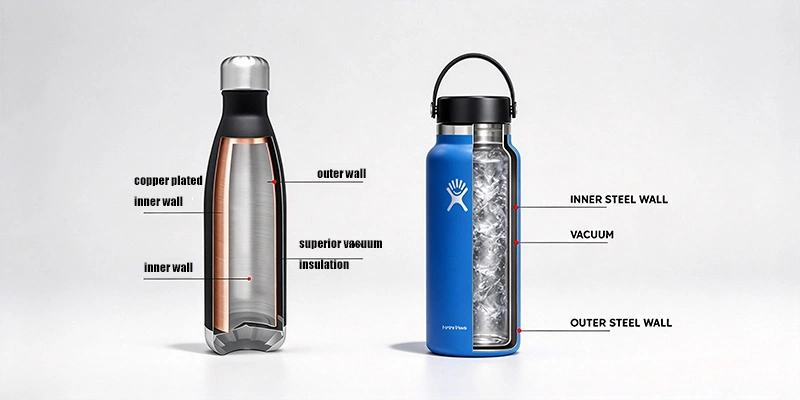
S’well’s Therma-S’well technology uses a triple-layer construction that includes two vacuum-insulated stainless steel layers and a copper layer. Hydro Flask’s standard insulated bottles use TempShield double-wall vacuum insulation.
Both designs aim to reduce heat transfer through the bottle walls, helping beverages stay hot or cold for extended periods.
For reference, S’well’s published specifications for its Original Bottle vary by capacity:
| S’well Original Bottle | Cold Retention | Hot Retention |
|---|---|---|
| 9 oz | Up to 24 hours | Up to 12 hours |
| 17 oz | Up to 36 hours | Up to 18 hours |
| 25 oz | Up to 48 hours | Up to 24 hours |
By comparison, Hydro Flask’s 20 oz Wide Mouth bottle is rated to keep drinks cold for up to 24 hours and hot for up to 12 hours.
In one reported thermal-drop test, water in a S’well Original 25 oz bottle took approximately 225 minutes to cool from 165°F to 150°F, while the tested YETI and Hydro Flask bottles took around 70 minutes.
If insulation performance is your top priority, S’well is undoubtedly the better fit based on the specifications and test results discussed above.
2. Which Bottle Is More Durable: S’well or Hydro Flask?
Durability is often a key consideration for both consumers and B2B buyers. If a water bottle loses its appearance and finish after just a few months, it may struggle to deliver long-term value.
2.1 How Do Surface Finishes Affect Bottle Durability?
Surface finishes are about more than appearance. They affect how a bottle looks and feels, as well as how noticeable wear becomes over time. S’well and Hydro Flask take different approaches, and these differences influence the appearance and feel of their bottles during everyday use.
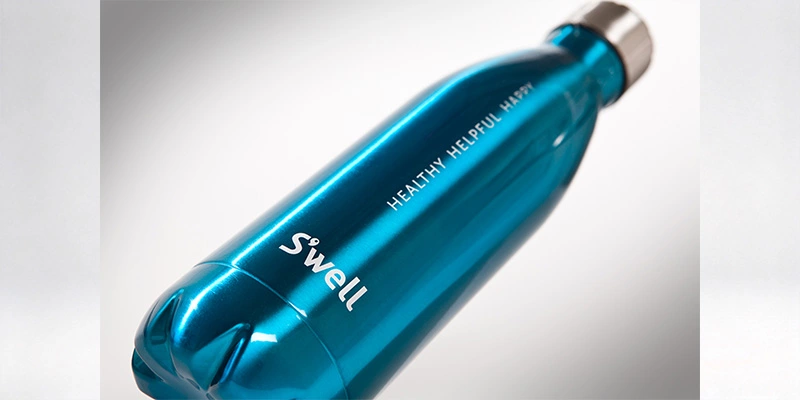
S’well focuses on a refined visual finish. Its bottles are known for polished metallic surfaces, decorative patterns, and a wide selection of colors. These finishes give the bottles a more sophisticated, premium look.
However, this approach also has a significant drawback: the decorative coatings on S’well bottles may fade or peel more easily after prolonged use. This can be particularly disappointing when appearance is one of the product’s main selling points.
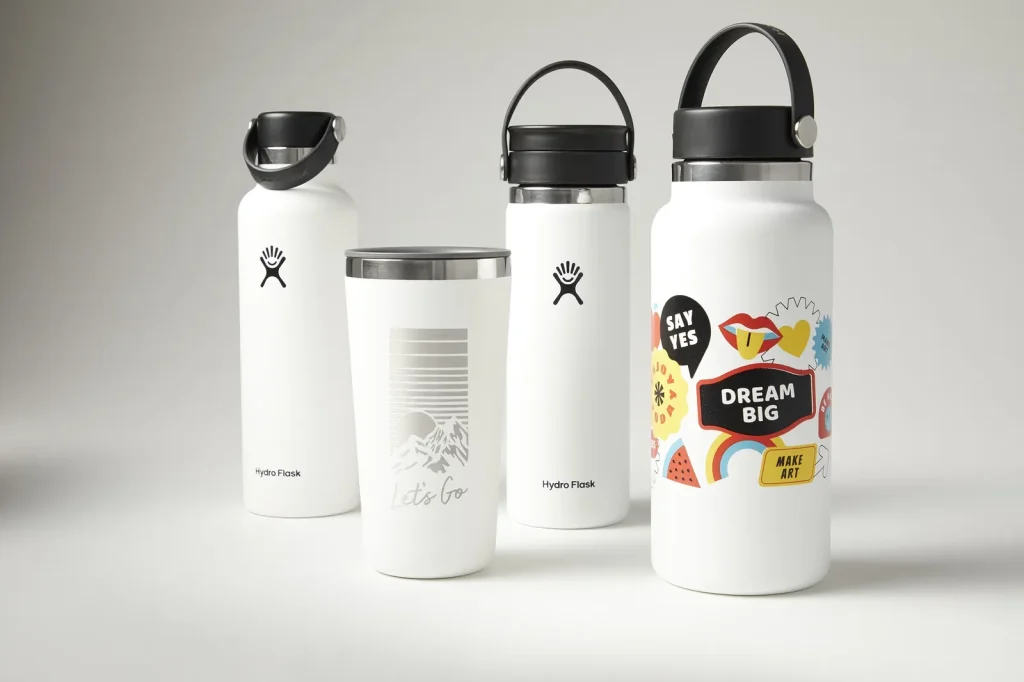
Hydro Flask bottles often feature matte powder coatings that create a practical, understated look for everyday use. These finishes are generally associated with good resistance to scratches, peeling, and wear.
When evaluating the durability of a bottle’s coating, however, we should not simply assume that metallic finishes scratch, peel, or wear more easily than powder coatings. Several factors need to be considered:
- Coating thickness: How thick is the coating, and is it appropriate for the intended application?
- Adhesion test results: How securely does the coating bond to the stainless steel surface?
- Abrasion resistance: How much friction can the coating withstand before showing signs of wear?
- Color retention: Does the finish maintain its original appearance after repeated use and cleaning?
- Chemical resistance: Can the coating withstand everyday cleaning products?
These factors are influenced by multiple stages of stainless steel bottle manufacturing.
For example, inadequate surface polishing can affect how well the coating adheres to the metal. Temperature control on the spray-coating production line and the amount of coating applied by the spray system can also affect coating thickness, adhesion, and consistency.
In other words, the final result depends not only on the type of coating but also on the manufacturer’s process control and production capabilities.
We cannot determine which surface finish is universally better without considering the manufacturing process and intended use.
Overall, if visual impact is your priority, S’well is an appealing choice. If long-term durability is more important, Hydro Flask is the better fit.
For B2B buyers, this distinction is particularly relevant. Bottles intended for corporate gifts should deliver a refined appearance and premium feel, while bottles supplied to outdoor retailers should prioritize durability.
2.2 Structural Integrity and Impact Resistance
Structural durability is another key difference between these two brands.
Both S’well and Hydro Flask use stainless steel for their insulated bottle bodies. However, the material grade alone does not determine how well a finished bottle withstands impacts. Wall thickness, bottle geometry, forming processes, base construction, and manufacturing quality all influence structural performance.
Hydro Flask uses robust stainless steel construction designed for everyday use and outdoor activities. Its overall product design supports a practical, outdoor-oriented positioning, making it a suitable choice for people who regularly take their bottles on hikes, camping trips, and other adventures.
S’well’s slim, refined design is less suited to rough handling. Its bottles can develop dents or scratches if dropped or handled carelessly.
This does not mean the manufacturing quality is poor. Rather, the product design serves a different purpose. S’well bottles are well suited to everyday environments such as offices, homes, and cafés, where their appearance and proportions are part of their appeal.
So, if you frequently use a bottle outdoors, Hydro Flask is the stronger choice. For everyday settings, the decision between S’well and Hydro Flask largely comes down to your preferences for appearance and functionality.
3. S’well vs. Hydro Flask: Which Offers a Better User Experience?
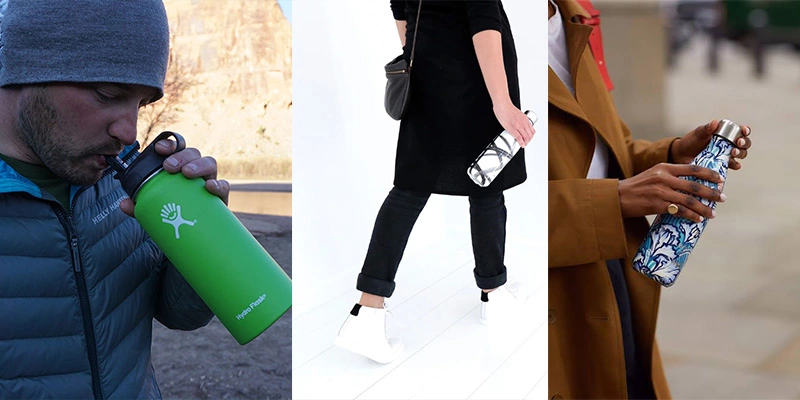
Insulation and durability are important, but the everyday experience is what turns a first-time buyer into a loyal customer. S’well and Hydro Flask offer two different approaches to usability.
3.1 Shape and Portability
S’well’s slim silhouette is one of its most recognizable features. Its narrow profile makes the bottle convenient to carry between home, work, and other everyday destinations. Depending on the size, it may also fit easily into a bag pocket or vehicle cup holder.
Hydro Flask offers a wider variety of bottle shapes and capacities, including larger bottles for users who want to carry more water throughout the day.
The trade-off is that larger bottles take up more space and may not fit smaller cup holders or bag pockets. Compatibility depends on the bottle’s exact dimensions and the available space.
For urban commuters, a slim bottle can be particularly appealing. For hikers, fitness enthusiasts, and people who prefer fewer refills, a larger-capacity bottle may be more practical.
3.2 Bottle Lids and Drinking Experience
S’well’s slim silhouette is one of its most recognizable features. Its narrow profile makes the bottle convenient to carry between home, work, and other everyday destinations. Depending on the size, it may also fit easily into a bag pocket or vehicle cup holder.
Hydro Flask offers a wider variety of bottle shapes and capacities, including larger bottles for users who want to carry more water throughout the day. The choice between a wide-mouth and standard-mouth bottle also affects everyday convenience and usability. Read our guide to Hydro Flask Wide Mouth vs. Standard Mouth to learn more.
The trade-off is that larger bottles take up more space and may not fit smaller cup holders or bag pockets. Compatibility depends on the bottle’s exact dimensions and the available space.
For urban commuters, a slim bottle can be particularly appealing. For hikers, fitness enthusiasts, and people who prefer fewer refills, a larger-capacity bottle may be more practical.
3.3 Cleaning and Adding Ice
The traditional S’well Original Bottle has a relatively narrow opening, which can make cleaning more difficult. A suitable bottle brush can help reach the interior more effectively.
Hydro Flask’s wide-mouth models offer easier access for cleaning and adding ice cubes. People who regularly add ice, fruit, or other ingredients may find a wider opening more convenient.
Care instructions also vary by product. Some current S’well Original Bottle models are labeled top-rack dishwasher safe, and the brand recommends following the care instructions for each specific product. Hydro Flask’s referenced Wide Mouth model is also labeled dishwasher safe.
For any bottle, follow the manufacturer’s instructions for the body, lid, and accessories rather than assuming every component can be cleaned in the same way.
3.4 Colors, Patterns, and Brand Identity
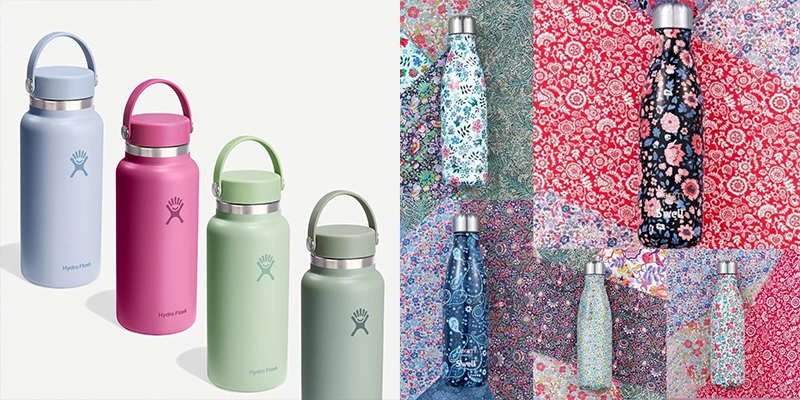
S’well’s visual appeal is an important part of its market positioning. Its collections feature a variety of colors, decorative patterns, and polished finishes, turning the bottle into a lifestyle accessory.
Hydro Flask also offers a wide range of colors, with many products featuring recognizable matte finishes and an outdoor-inspired look.
S’well’s refined appearance works particularly well in fashion-oriented retail, corporate gifting, and premium lifestyle collections. Hydro Flask’s more practical styling fits naturally into outdoor equipment, travel products, and active-lifestyle retail.
For B2B buyers, this comparison highlights an important principle: colors, textures, shapes, and surface finishes all help communicate a product’s intended audience.
A successful product does not need to look like either brand. It needs a design language that makes sense for its own customers.
4. S’well vs. Hydro Flask: Which Brand Offers Better Value for Money?
S’well and Hydro Flask both occupy the premium reusable insulated water bottle market, and their retail prices are generally comparable. However, each brand’s premium positioning comes from different strengths.
4.1 S’well Water Bottles
S’well customers pay for refined aesthetics and a distinctive brand identity. They value the bottle as both a functional product and a stylish everyday accessory.
S’well is particularly suitable for:
- Premium lifestyle retailers.
- Boutique gift shops.
- Corporate gifting programs.
- Consumers who value appearance and thermal performance.
For these customers, a bottle’s visual appeal can be an important part of the purchasing decision.
4.2 Hydro Flask Water Bottles
Hydro Flask emphasizes practical hydration, versatile bottle configurations, and a clear outdoor-oriented identity.
It is particularly suitable for:
- Outdoor and sporting goods retailers.
- Fitness and travel-related brands.
- Active-lifestyle retailers.
- Consumers who prioritize practical functionality.
For these customers, convenience and versatility may matter more than a highly decorative finish.
4.3 Which Offers Better Value?
There is no universal winner.
S’well may offer better value for people who prioritize an elegant appearance and strong insulation performance. Hydro Flask may offer better value for those who want a more versatile bottle with practical drinking options.
The same principle applies to commercial buyers. The lowest purchase price does not necessarily deliver the best result if the product fails to meet customer expectations.
The better investment is the product whose features, quality, and market positioning justify its price.
5. What Can B2B Buyers Learn from S’well and Hydro Flask?
As the comparison above shows, neither brand makes a perfect bottle for every user. However, understanding the product decisions behind their success can help brands, wholesalers, and corporate buyers make better sourcing and product development decisions.
5.1 Define Your Stainless Steel Water Bottle Specifications
The opening diameter, insulation structure, surface finish, capacity, and lid design all affect the final product.
- Bottle opening: Opening size influences the convenience of adding ice and cleaning the bottle, the drinking experience, and heat exchange when the bottle is open. It also affects whether the bottle can achieve a slim silhouette.
- Surface finish: The finish creates the first visual impression of a bottle. Glossy surfaces and metallic coatings suit a more fashion-oriented position, while matte powder coatings support a practical, understated look. Learn more about different finishing options in our custom water bottle surface finishing guide.
- Capacity: From compact bottles for commuting to larger bottles for travel and outdoor activities, the right capacity depends on your target customers and market positioning.
- Lid design: A lid is no longer just an accessory for an insulated bottle. It directly shapes the drinking experience, and a bottle that customers rarely use is unlikely to succeed in the market. Learn more in our complete guide to stainless steel bottle lids.
- Insulation: Insulation is a basic requirement for stainless steel vacuum bottles. Many established products already meet common thermal performance expectations, so it can be difficult to differentiate a product through insulation alone. Other design choices may offer greater opportunities to stand out. Learn more about vacuum-insulated stainless steel bottle design and double-wall bottle manufacturing techniques.
These decisions should be made together. A bottle’s shape, capacity, opening, and lid all affect the appearance and functionality of the finished product.
5.2 Match the Design to Your Target Market
- Premium corporate gifts may prioritize refined aesthetics, consistent color matching, high-quality logo application, and attractive packaging.
- Outdoor hydration products may prioritize capacity, convenient drinking, a practical grip, and resistance to everyday wear.
- Lifestyle retail collections may benefit from recognizable shapes, distinctive colors, and multiple finishes that create a cohesive product range.
The goal is not to copy S’well or Hydro Flask feature by feature. It is to understand why certain features work for their audiences and apply those lessons to your own market positioning.
6. How to Evaluate a Stainless Steel Water Bottle Manufacturer
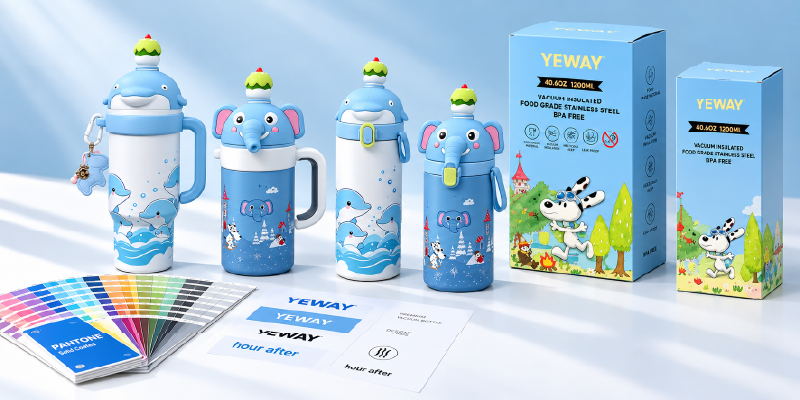
Once you have defined your product specifications, the next step is finding the right insulated water bottle manufacturing partner.
The following criteria can help you distinguish a reliable manufacturer from a potentially risky supplier.
- Vacuum technology: Can the manufacturer clearly explain its vacuum extraction process, including evacuation time, target vacuum levels, and verification methods?
- Quality control: Are vacuum integrity, coating adhesion, and thread fit thoroughly inspected?
- Testing equipment: Does the manufacturer have appropriate equipment, such as helium mass spectrometer leak detectors, thermal imaging systems, and coating thickness gauges, where relevant?
- International compliance: Can the supplier provide applicable FDA, LFGB, and REACH compliance documentation, along with SGS test reports when required?
- Traceability: Can the manufacturer provide production batch records that support traceability from raw materials to finished products?
- Communication: Can the team provide clear, timely answers to technical questions?
A reliable manufacturing partner should be able to explain its capabilities, identify potential production risks, and help you determine whether your specifications are practical for mass production.
7. Conclusion
The main difference between S’well and Hydro Flask is not simply manufacturing or craftsmanship. It is how each brand defines its product and optimizes its design for a particular audience.Both brands have established clear market positions and developed products around the needs of their customers.
When planning your next sourcing or product development project, do not focus only on the question, “Which brand is better?” Instead, ask yourself:
- Who are my target customers?
- Where will they use the bottle?
- Which features matter most to them?
- Which design best represents my brand?
Successful product design starts with understanding your target customers, not simply stacking functions.
Ready for Your Next Stainless Steel Water Bottle Project?
At YEWAY, we support brands, wholesalers, and corporate buyers in developing stainless steel water bottles and other drinkware products for different markets.From product specifications and surface finishes to logo customization and packaging, our OEM/ODM services help turn your product concept into a manufacturing plan.
Explore our stainless steel water bottle OEM/ODM services or browse our wholesale insulated water bottles to explore options for your next product collection.
Contact YEWAY to discuss your project and develop a bottle that fits your customers, your brand, and your market.
8. Frequently Asked Questions About S’well vs. Hydro Flask
Is S’well better than Hydro Flask?
S’well is a strong option for buyers who prioritize a sleek design, decorative finishes, and insulation performance. Hydro Flask is a strong option for buyers who value practical functionality, versatile lid options, and outdoor-oriented use.
The better choice depends on the specific model and the intended application.
Which keeps drinks hotter for longer, S’well or Hydro Flask?
Published insulation claims vary by model and capacity. S’well’s Original Bottle range lists different hot-retention times for its 9 oz, 17 oz, and 25 oz versions. Hydro Flask’s 20 oz Wide Mouth is rated for up to 12 hours hot.
For an accurate comparison, compare specific models and use the same test conditions.
Is S’well worth the money?
S’well may be worth the price for people who value its slim silhouette, decorative finishes, and thermal performance. Buyers who prioritize a wide opening, interchangeable lid options, or a more practical outdoor-oriented design may prefer Hydro Flask.
Is S’well dishwasher safe?
Care instructions depend on the specific product. The current S’well Original Bottle 25 oz listing states that it is top-rack dishwasher safe or can be washed by hand with warm, soapy water. Always check the instructions for your particular bottle and its cap.
Which bottle is easier to clean?
Hydro Flask’s wide-mouth models generally provide easier access to the interior for cleaning. The traditional S’well Original Bottle’s narrower opening can make cleaning more difficult, although a suitable bottle brush helps.
Are S’well bottles BPA-free?
S’well’s Original Bottle is listed as BPA- and BPS-free by the manufacturer. Check the relevant product information for the specific bottle and accessories you are considering.
Which bottle is better for commuting and cup holders?
S’well’s slimmer models can be convenient for commuting and everyday carrying. However, cup-holder fit depends on the bottle’s exact dimensions and the size of the holder. Hydro Flask also offers different sizes, so compare the base diameter of the specific model before purchasing.