“Why does this batch feel lighter?” / “Why are customers saying the ice melts in four hours?”
If you’re a brand owner or a high-volume distributor, these are the questions that keep you up at night. You’ve spent months on marketing and design, only to have your brand’s reputation dinged by a faulty vacuum seal.
At YEWAY factory, we’ve analyzed thousands of “failed” bottles from across the industry. Here’s the truth: A vacuum bottle isn’t just a piece of metal; it’s a precision instrument. When it fails, it’s usually because of one of three “invisible” manufacturing shortcuts.
01
The “Quick-Cool” Shortcut
In the rush to meet massive Q4 deadlines, some factories shorten the vacuum exhaust time. It saves electricity and speeds up production, but it leaves residual air inside the double walls.
Your “24-hour cold” claim becomes an “8-hour reality,” leading to negative reviews and returns.
We use a proprietary slow-vacuum process. It takes longer, but ensures a near-perfect vacuum state that lasts.
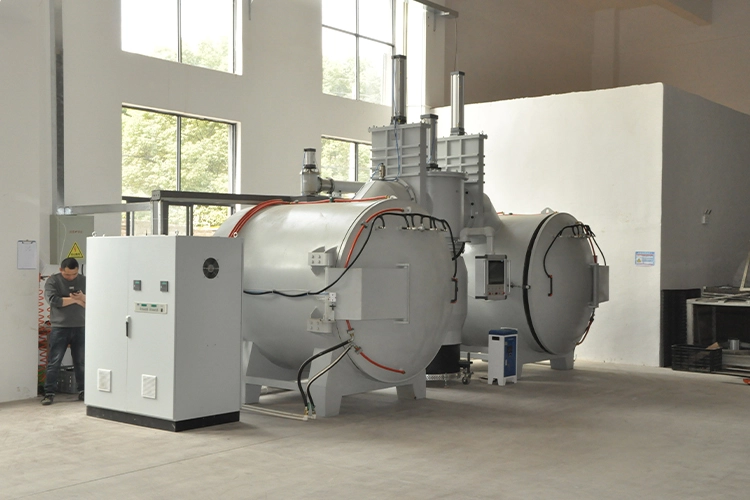
YEWAY High-precision vacuum exhaust process ensuring 24-hour temperature retention
02
The Micro-Leak in the Welding Seam
Stainless steel looks tough, but the welding at the base is delicate work. If laser welding isn’t calibrated to the exact micron, a micro-leak can develop that is invisible to the naked eye.
A bottle that “sweats” on the outside, ruining your customer’s wooden desk and their experience.
Every batch undergoes a Long-Term Heat Retention Test. We submerge and monitor temperatures over 12-24 hours. If a single bottle deviates from the standard, the entire line is re-inspected.
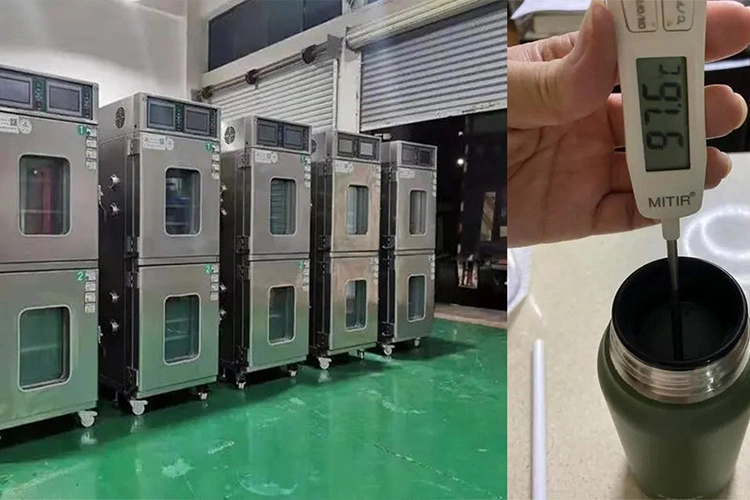
Rigorous heat retention testing for bulk stainless steel water bottle manufacturing
03
Material Impurities (304 vs. 201)
On paper, it says “18/8 Stainless Steel.” But lower-grade scrap metal mixed into the melt causes internal corrosion. Once the wall pits, the vacuum integrity is gone.
An unpleasant metallic taste and a bottle that eventually stops holding temperature altogether.
We perform random Spectrometer Lab Testing on every coil of steel that enters our warehouse.
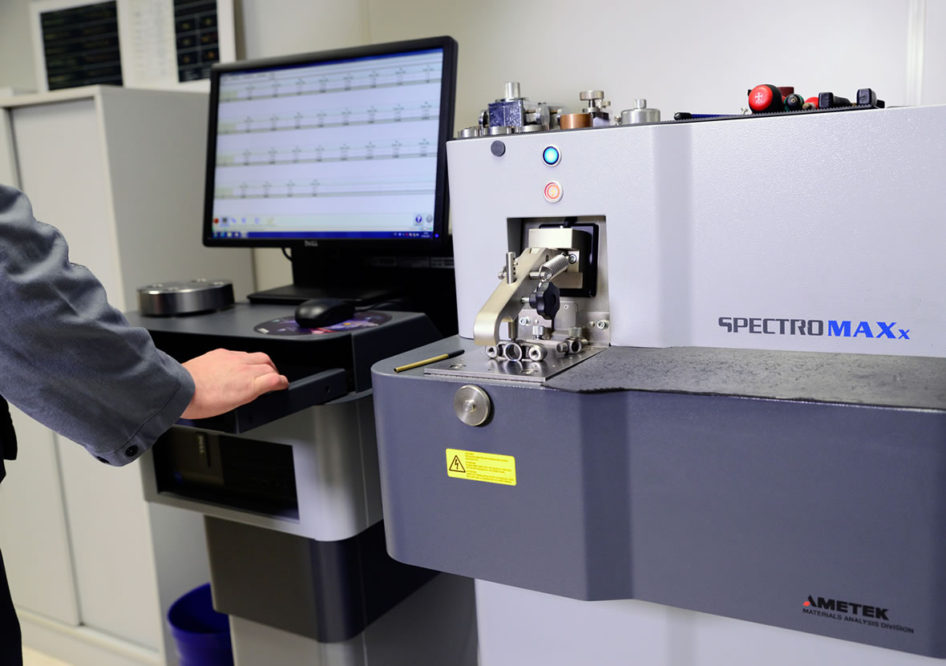
YEWAY Raw material inspection using spectrometer for 304/316 food grade stainless steel
The Bottom Line
In the B2B world, the cheapest quote is often the most expensive one in the long run. We don’t aim to be the cheapest factory; we aim to be the most reliable partner for your brand’s growth.
Want to see the proof?
I’d be happy to hop on a quick video call and show you our Thermal Testing Lab in action. No sales pitch—just transparency.