
Engineering & Procurement Insights
In the competitive landscape of wholesale stainless steel bottles, the choice between SUS 304 and SUS 316 is the thin line between a commodity and a luxury asset. For a B2B water bottle manufacturer, this isn’t just a technical spec—it’s a strategic pivot that dictates manufacturing ROI and long-term brand equity. This definitive guide decodes the metallurgical science behind these alloys, helping you navigate the complexities of procurement with confidence and precision
| Feature / Metric | SUS 304 (Standard) | SUS 316 (Premium) | B2B Strategic Impact |
|---|---|---|---|
| Pitting Resistance | PREN ~18.0 | PREN ~24.0 | 316 offers 33% higher resistance to salt/chlorides; dramatically reduces rust claims. |
| Chemical Edge | 18% Chrome, 8% Nickel | 16% Chrome, 10% Ni, 2% Mo | The addition of Molybdenum makes 316 exceptionally stable in acidic environments. |
| Taste Neutrality | Good (Everyday use) | Excellent (Medical Grade) | Essential for premium brands; prevents metallic aftertaste in coffee and tea. |
| Market Position | Mass / Corporate Gift | Luxury / Performance | 316 justifies a 20-35% price premium, elevating your brand’s market perceived value. |
SUS 304: The Global Industry Standard
Commonly known as 18/8 stainless steel, SUS 304 is the gold standard for custom vacuum flask production. Composed of 18% chromium and 8% nickel, it provides a robust protective oxide layer that resists most domestic corrosion. Its widespread adoption in the US and EU markets is due to its exceptional balance of durability, safety, and price-point efficiency.
- Manufacturing Versatility: 304 is highly ductile, making it the preferred choice for complex industrial designs, slim silhouettes, and innovative bottle shapes that define modern lifestyle brands.
- Safety & Compliance: It is naturally BPA-free and fully meets FDA (US) and LFGB (Germany) food-grade certifications, ensuring it is safe for 95% of daily hydration needs.
- Cost Optimization: For high-volume wholesale stainless steel bottles, 304 offers the best ROI for gift markets and corporate promotions.
Laboratory Insight: Salt Spray Testing
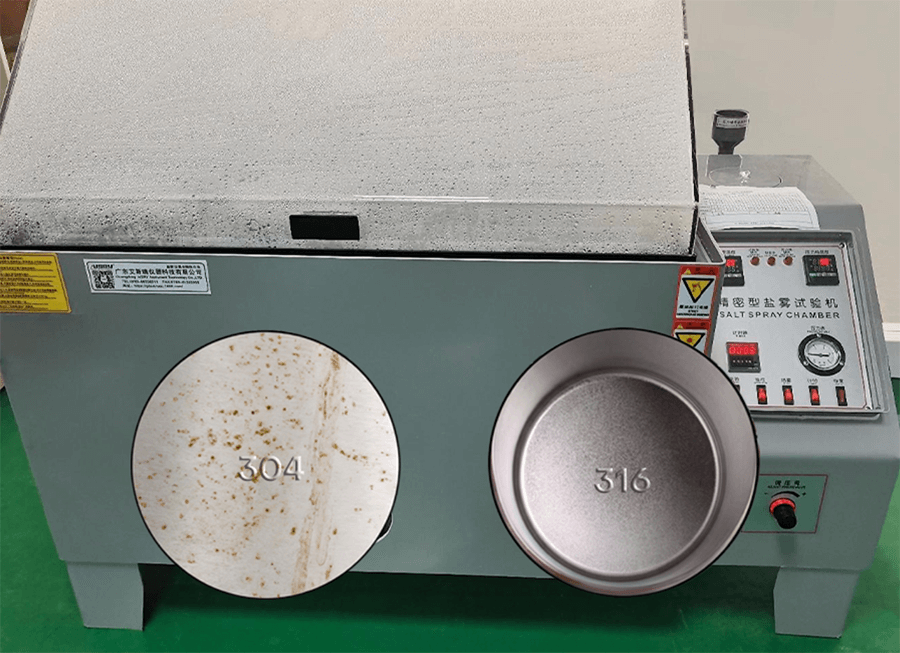
YEWAY Laboratory Salt Spray Test Results. After 72 hours of exposure, SUS 316 maintains structural integrity without surface oxidation, whereas standard 304 begins to show signs of micro-pitting.
In our laboratory, we conduct rigorous Salt Spray Testing to simulate years of usage. While SUS 304 performs admirably in standard conditions—staying rust-free for 48 hours in a high-saline mist—SUS 316 often exceeds 72 to 96 hours. This extra buffer is why we recommend 316 for maritime brands or professional outdoor gear used in coastal environments.
Beyond the Alloy: The Role of Electropolishing
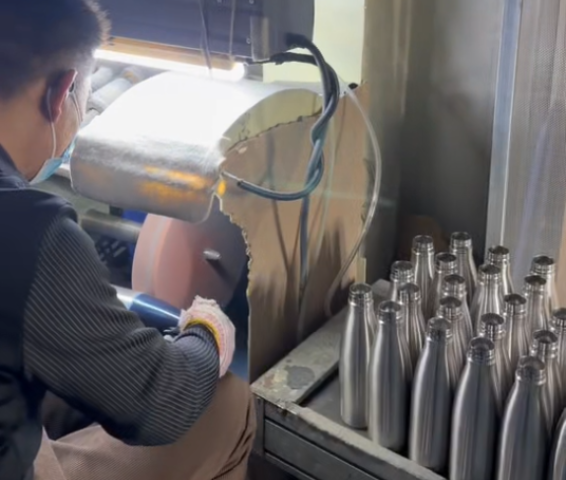
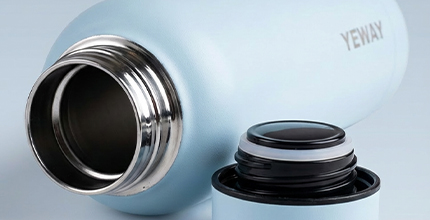
Our specialized electropolishing technique. As a leading B2B water bottle manufacturer, YEWAY utilizes this process to ensure a smooth, mirror-like interior that resists bacterial buildup and enhances the longevity of our wholesale stainless steel bottles.
In our custom vacuum flask production line, we don’t just stop at the material choice. We apply an advanced electropolishing process to the inner walls. This electrochemical treatment creates a mirror-like finish that further enhances the corrosion resistance of both 304 and 316. By removing microscopic peaks and valleys, we prevent bacterial growth and ensure the bottle is effortless to clean for the end-user.
Say Goodbye to the “Metallic Taint”: The Flavor Science of 316 Steel
Have you ever had a perfect cup of coffee ruined by a subtle metallic tang? We have, and it’s a dealbreaker. That’s why we advocate for 316 stainless steel for high-end drinkware.
What sets SUS 316 apart is the strategic addition of 2-3% Molybdenum. The addition of Molybdenum makes the surface almost entirely inert. It doesn’t “soak up” old flavors or let odors linger, so a morning tea won’t taste like yesterday’s dark roast
We also take our craftsmanship seriously. Using advanced laser welding on 316 steel creates a rock-solid bond that protects the vacuum layer. The result? A bottle that performs as perfectly on day 1,000 as it did on day 1.
B2B Market Strategy: Maximizing Your ROI
While SUS 316 carries a higher manufacturing cost, its commercial value in the European and American markets cannot be overstated. Today’s consumers are increasingly health-conscious and willing to pay for “Medical Grade” security.
For Purchasing Managers: 304 remains the “efficiency king” for high-volume corporate distribution. It maintains a premium feel while keeping your acquisition cost low.
For Brand Owners: If you are targeting the $40+ premium retail price point, 316 is your strongest marketing asset. By positioning your product as “316 Marine Grade,” you provide a scientific justification for higher prices, which typically results in 40% higher profit margins per unit compared to entry-level 304 models.
Optimize Your Production Today
As a dedicated B2B water bottle manufacturer, YEWAY provides full material transparency and laboratory support for your custom vacuum flask production needs.
Leave a Reply